
Commercial Roof Leak Damage Repair Tampa
Commercial roof leak detection and repair across Tampa - infrared moisture scanning, core sampling, source tracing through Tampa Bay's afternoon thunderstorm cycles, and permanent repair documentation for occupied commercial buildings.
Tampa Bay's June-through-September afternoon thunderstorm season delivers 35 to 40 of the metro area's 47 annual rainfall inches in a four-month window - which means commercial flat roof leaks in Tampa compound faster and cause more interior damage than in markets with distributed rainfall. Finding the source and fixing it permanently is the standard; temporary patches that re-leak in the next storm are not.
Roof leak repair on a commercial flat roof in Tampa is complicated by a simple geographic fact: the source of a roof leak is almost never directly above the interior water intrusion point. Water enters the membrane or flashing at one location, travels horizontally through the insulation and along the deck slope, and exits at the interior at whatever low point it finds - sometimes a ceiling tile joint 30 feet from the actual membrane breach. The traditional method of tracing from the interior stain to the roof directly above it and patching that area produces a high re-leak rate because it addresses the symptom, not the source.
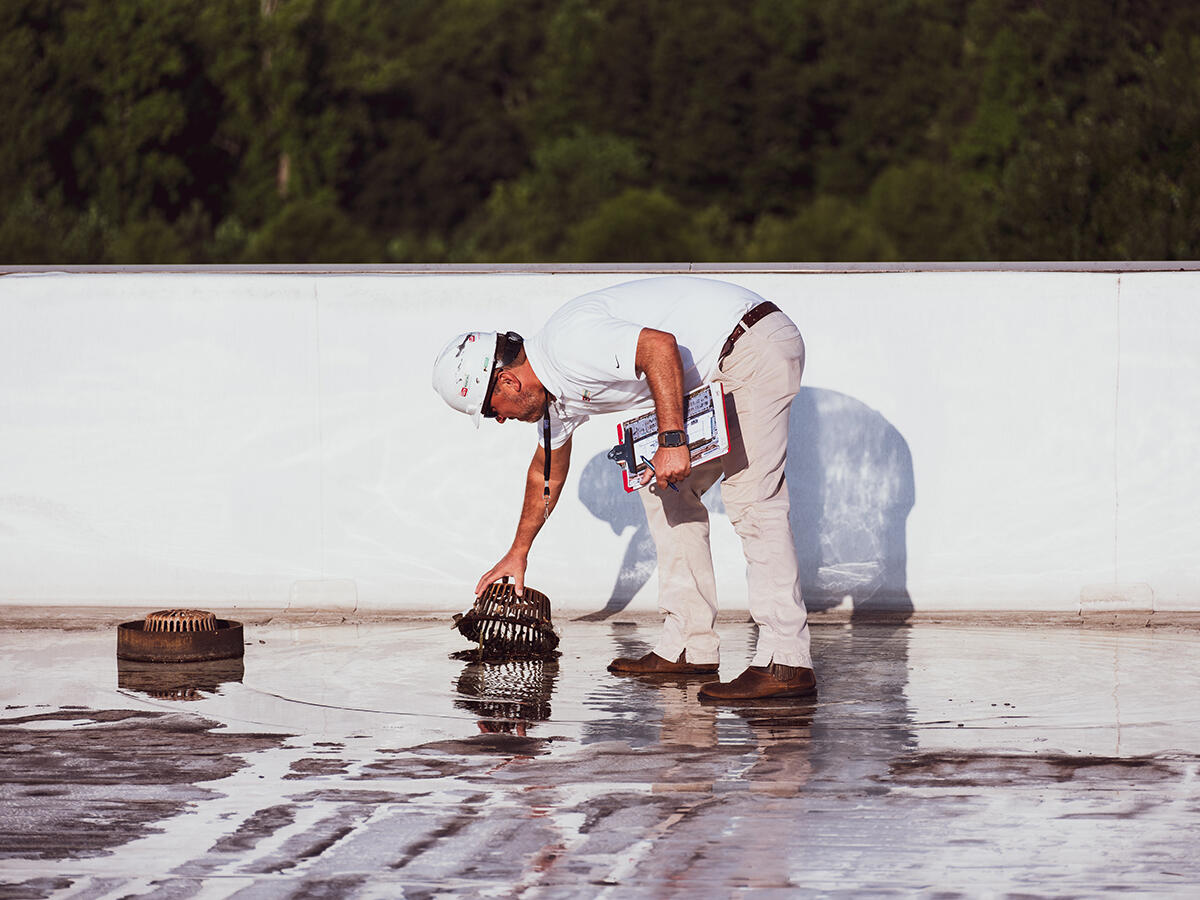
We trace leaks from the source, not from the interior. The starting point is a systematic roof walk that checks the most common failure locations in order: penetration flashings at HVAC curbs, pipe boots, and conduit penetrations; parapet flashing at the coping and base flashing terminations; seams and laps in the field membrane; drain bowls and overflow drains; and any previous repair patches that have aged. We correlate what we find with the interior leak location and the building's roof slope-to-drain diagram to identify the plausible water travel path. Infrared moisture scanning - conducted in the evening when the roof surface has cooled and wet insulation retains heat differently than dry insulation - maps the moisture distribution to identify the horizontal extent of the saturation and narrow the source search.
Tampa Bay's afternoon thunderstorm cycle creates a specific diagnostic challenge: leaks that only manifest during or immediately after the daily summer storms may not produce a consistent water path visible on the interior between storm events. We schedule diagnostic inspections to include a hose test of suspected source areas - systematically wetting each candidate location in isolation while a second person monitors the interior - to isolate the source without waiting for the next natural rain event. This approach shortens the diagnostic cycle and prevents interior damage from accumulating through additional storm events while the source is still unidentified.
Common Leak Sources on Tampa Bay Commercial Flat Roofs
HVAC curb flashings are the most common leak source on Tampa Bay commercial flat roofs because the daily thermal cycle in the subtropical climate - hot roof surface during the day, rapid cooling during afternoon storms - works the curb flashing's pitch pocket or wrap-around membrane through more expansion and contraction cycles per year than any other climate in North America. HVAC equipment is also a source of foot traffic damage: service technicians regularly walk directly across the curb flashing to reach equipment, and the traffic abrades the membrane surface and compresses the flashing seal over time.
Drain area failures are the second most common source. Tampa Bay's drainage intensity during afternoon thunderstorms - 1.5 to 2 inches per hour is not uncommon during peak convective events - surges drain bowls with a volume that leaves debris suspended above the strainer. The organic debris that accumulates around drain bowls in a subtropical climate - palm fronds, leaf litter from the oak canopy that characterizes older Tampa commercial properties - degrades the membrane in the drain sump area through biological contact and physical abrasion. Drain bowl membrane failures begin as small cracks or splits at the clamping ring edge and are easy to miss in a casual roof inspection.
Parapet cap flashing at the corner miters is the third common source. Tampa Bay's stainless-steel, aluminum, and sheet-metal parapet caps are joined at corners with mitered joints that are caulked with elastomeric sealant. The coastal salt-air environment and the thermal cycle degrade the caulk joint faster here than in inland markets - most parapet cap caulk joints on coastal Tampa buildings have a realistic service life of five to seven years, not the ten to fifteen years that standard maintenance schedules assume. Corner joints that have opened allow wind-driven rain to enter the parapet cavity and migrate down the interior wall face.
Infrared Moisture Scanning for Tampa Bay Commercial Roofs
Infrared moisture scanning is the most efficient method for mapping moisture distribution in a commercial flat roof system across a large area. The scan is conducted in the evening - typically starting 30 to 45 minutes after sunset - when the roof surface has cooled to near ambient temperature but wet insulation retains the daytime heat load and appears warm relative to dry insulation on the infrared image. Tampa Bay's warm nights and high ambient humidity require careful interpretation because warm ambient temperature reduces the thermal contrast between wet and dry insulation compared to cooler climates. We adjust the scan protocol for Tampa Bay's specific thermal conditions.
The infrared scan produces a thermal map of the roof surface that shows the moisture distribution pattern across the entire scanned area. This map is overlaid on the roof plan to identify the extent of saturated insulation, the likely water travel path from source to extent of saturation, and the areas where core sampling should be concentrated for physical confirmation. Physical core samples at locations flagged by the infrared map confirm the wet/dry classification - infrared identifies moisture distribution, not absolute moisture content, and a physical core is always required to confirm the infrared finding before a repair scope is written.
For Tampa Bay commercial buildings where moisture distribution maps are needed for capital planning rather than for leak source diagnosis - buildings approaching end of warranty life, buildings being evaluated for sale or acquisition, or buildings where the property owner needs a documented moisture inventory before authorizing a replacement budget - we produce a full-roof infrared moisture map with core sample confirmation at representative locations as a standalone deliverable. This deliverable is useful for decisions about whether to repair, recover, or replace the existing system.
Roof review
Get a written Tampa Bay commercial roof scope.
We document the roof condition, separate urgent repairs from capital work, and give ownership a practical path before money gets spent.