
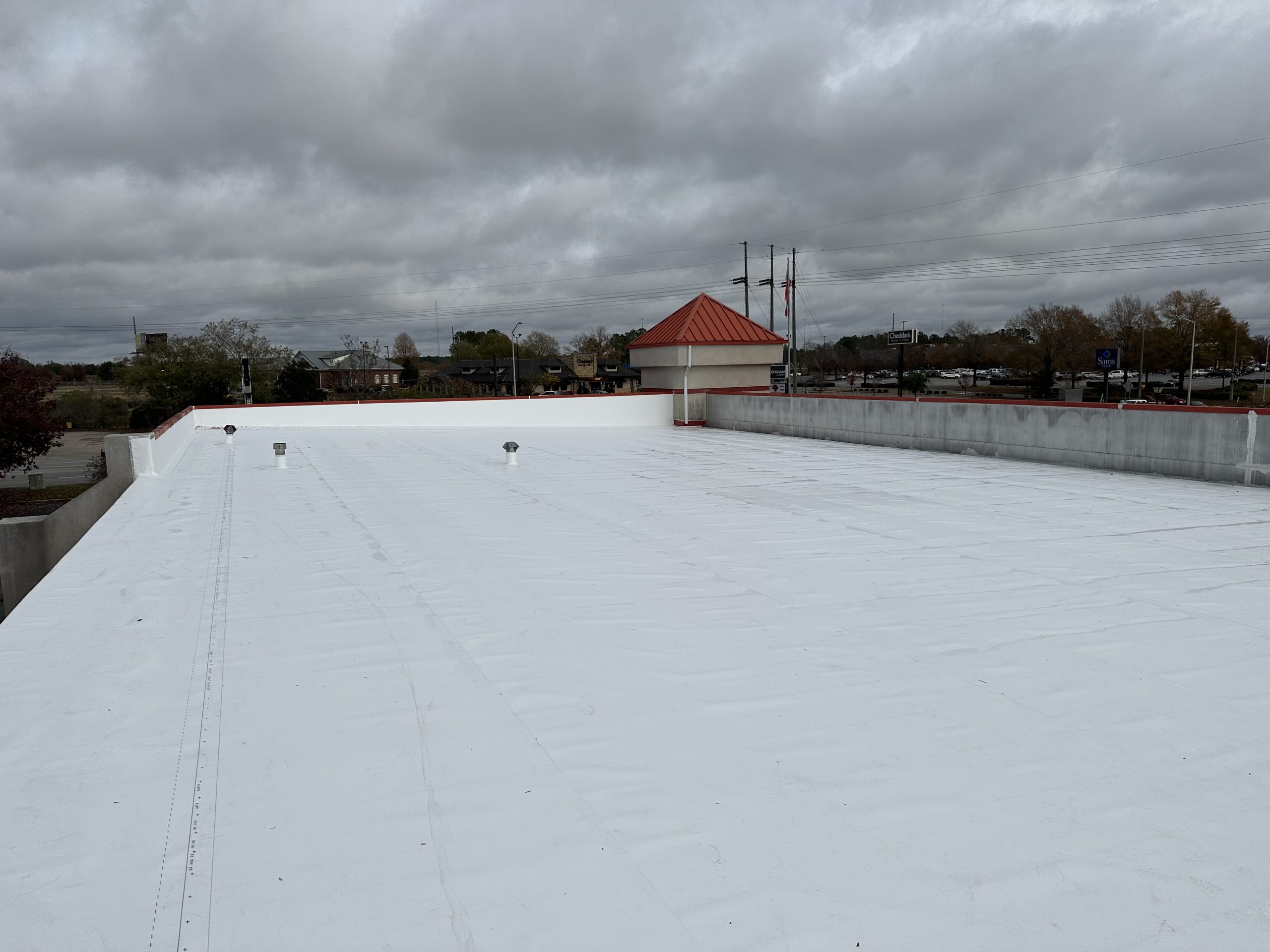
PVC Roof Systems Tampa Bay
PVC single-ply roofing for Tampa Bay commercial buildings - Miami-Dade NOA-approved assemblies, chemical and grease resistance for restaurant and food-service buildings, FBC HVHZ wind-uplift engineering.
Polyvinyl chloride membrane is the correct specification for Tampa Bay commercial buildings with grease exhaust, chemical exposure, or rooftop kitchen equipment - and for buildings where a heat-welded seam system and plasticizer migration resistance are priorities. Miami-Dade NOA-approved PVC assemblies meet FBC HVHZ wind-uplift requirements for coastal Hillsborough and Pinellas buildings.
PVC roofing accounts for a smaller share of the Tampa Bay commercial roof market than TPO or EPDM, but it is the correct system for a defined set of building types - and those are the buildings where specifying TPO or EPDM is the specification error. Restaurant buildings with rooftop exhaust fans, food processing facilities in the Port Tampa Bay logistics district, commercial kitchens in Ybor City's hospitality corridor, and pharmaceutical processing buildings in the USF Research Park area are the primary PVC candidates in this market. PVC's resistance to grease, oils, and a range of chemical compounds is not a marketing claim - it is a measurable material property that makes PVC the correct membrane when grease exhaust contacts the roof surface.
TPO, which is chemically similar to polypropylene, degrades when petroleum-based grease contacts the membrane surface repeatedly. The degradation is visible as membrane softening and discoloration at the exhaust fan discharge radius. Buildings where TPO has been installed under rooftop kitchen exhaust fans show accelerated membrane degradation at those locations - often within three to five years of installation - that voids the manufacturer warranty because grease contamination is an excluded condition. PVC does not share this vulnerability.
For Tampa Bay coastal buildings in the HVHZ exposure zone, PVC assemblies with Miami-Dade NOA approvals are available from major manufacturers - Duro-Last, Sarnafil, Versico, and Carlisle - and the NOA-tested design pressures for fully adhered PVC assemblies achieve the perimeter and corner zone requirements for most Hillsborough and Pinellas coastal commercial buildings. We specify NOA-approved PVC assemblies on coastal exposure projects the same way we approach TPO specification: the NOA approval drives the insulation selection, attachment method, and fastener pattern.
PVC and Grease Exhaust - Tampa Bay Food Service and Hospitality Buildings
Ybor City's commercial restaurant and entertainment inventory - the Columbia Restaurant block on Seventh Avenue, the cluster of bar and restaurant buildings along the Seventh and Ninth Avenue corridors, and the food service operations in the Centro Ybor complex - represents a concentration of rooftop kitchen exhaust situations that makes PVC the correct membrane for the roofing scope on these buildings. A building with three to five rooftop exhaust fans running full kitchen operations from 11 AM through 2 AM daily is depositing grease aerosol on the membrane within the three to five foot radius of each fan discharge.
We have assessed Ybor City commercial buildings where TPO was installed under kitchen exhaust fans within the prior eight years and the membrane at those locations is visibly degraded - soft, discolored, and failing the pull-tab test that confirms membrane integrity. The rest of the roof is in acceptable condition, but the exhaust fan zones are already requiring remediation. In those cases, we specify PVC as the replacement system - not just patching the exhaust fan zones with PVC cut-in sheets, which is a temporary fix that creates a seam compatibility problem between PVC and TPO.
For Channelside and Water Street Tampa hospitality buildings with rooftop kitchen operations, the same grease exhaust analysis applies. New construction in the Water Street Tampa development district using TPO under kitchen exhaust should expect to be back on the roof within five to eight years at those locations. We recommend PVC for the full scope on buildings where grease exhaust is the predominant roof surface exposure - the installed cost difference between TPO and PVC on a 10,000-square-foot restaurant roof is smaller than the cost of one premature TPO failure at the exhaust fan zones.
PVC Membrane Performance Under Tampa Bay's UV and Thermal Load
PVC membrane contains plasticizers that maintain flexibility in cold temperatures. Tampa Bay's climate does not produce cold-temperature stress, but solar UV loading at this latitude - approximately 27 degrees north - is significant. Plasticizer migration out of the membrane surface layer under sustained UV exposure is the primary aging mechanism for PVC in Tampa Bay's climate. Properly formulated PVC membranes from major manufacturers have addressed this with UV-stabilized formulations that slow migration, but it remains the primary inspection focus during annual maintenance.
Annual inspection of PVC systems in the Tampa Bay market includes a membrane hardness check at south- and west-facing sections - the highest UV-load orientations - to detect early plasticizer migration before the membrane becomes brittle at laps and penetration flashings. Early-stage migration is manageable with a topical plasticizer treatment. Advanced migration that has progressed to membrane brittleness at seam edges requires seam repair or, in severe cases, replacement of the affected sections.
PVC heat-welded seams are mechanically stronger than EPDM tape-bonded seams and have a different failure mode. Rather than delaminating from the seam tape, PVC seams fail at the seam edge when the membrane becomes brittle from plasticizer migration. Annual seam probe work on PVC systems focuses on the seam edge condition - running a finger along the seam edge and feeling for brittleness or cracking - rather than the delamination probe used for EPDM seam inspection.
Roof review
Get a written Tampa Bay commercial roof scope.
We document the roof condition, separate urgent repairs from capital work, and give ownership a practical path before money gets spent.