
EPDM Roof Systems Tampa Bay
EPDM rubber membrane roofing for Tampa Bay commercial buildings - fully adhered and mechanically attached assemblies, Miami-Dade NOA compliance, salt-air hardware specification, and hurricane wind-uplift engineering.
Ethylene propylene diene monomer membrane has a well-documented service life in the Tampa Bay market - and a specific set of installation requirements in the Florida Building Code HVHZ coastal exposure environment that change how adhesive selection, seam detail, and fastener specification are approached compared to inland markets.
EPDM was the dominant commercial flat-roof membrane in Tampa Bay through the 1990s and into the early 2000s. A large portion of the TIA-adjacent industrial and logistics inventory, the Pinellas Park industrial corridor, and the older Westshore office stock was installed with EPDM in that window. Buildings in this age range are in active reroof cycles, and the EPDM assessment work we conduct regularly turns up conditions specific to Tampa Bay's operating environment: insulation saturation from the subtropical rainfall pattern, adhesive bond degradation from the high-humidity environment that slows curing and accelerates aging, and salt-air corrosion on metal components in coastal exposure buildings.
EPDM in Tampa Bay is almost always specified fully adhered for coastal buildings where the Miami-Dade NOA design pressure requirement at the perimeter and corner zones exceeds what mechanically attached EPDM configurations achieve. Fully adhered EPDM distributes wind-uplift load across the entire bonded membrane area rather than concentrating it at discrete fastener points, and the tested design pressures for fully adhered NOA-approved configurations typically exceed those of mechanically attached configurations at equivalent installed cost on smaller roof areas. For the large-footprint warehouse buildings in the Pinellas Park and Port Tampa Bay ring, mechanically attached configurations with the correct zone-differentiated fastener pattern are viable and cost-effective.
We do not have a default EPDM specification that we apply to every building. The adhesive type - water-based bonding adhesive versus solvent-based versus low-VOC for occupied buildings - the seam sealant, the insulation product, and the attachment method are all selected based on the building's coastal exposure classification, its deck type, its Miami-Dade NOA required design pressure, and the operational constraints of the installation - Tampa Bay's subtropical humidity in the summer months affects adhesive cure rates in ways that matter for scheduling.
Fully Adhered EPDM in Tampa Bay's Subtropical Humidity
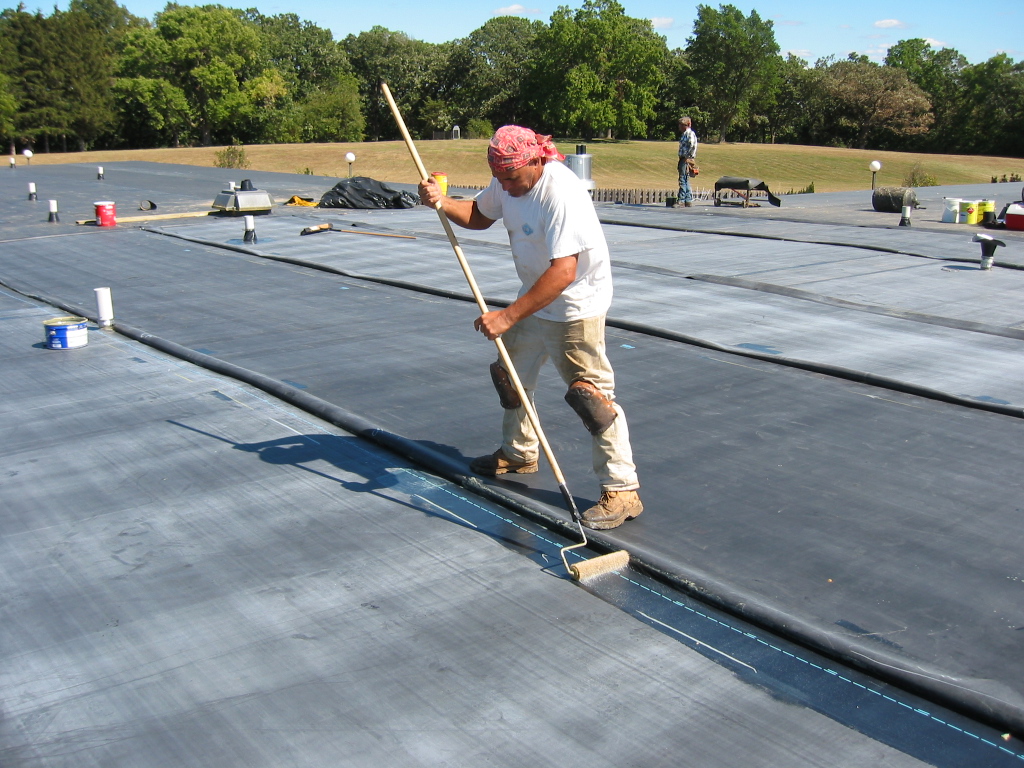
Fully adhered EPDM installation requires bonding adhesive applied to both the membrane underside and the insulation top surface, allowed to flash off - partially cure to a tack-free surface - before the membrane is rolled into contact with the insulation. In Tampa Bay's June through September humidity window, flash-off time for solvent-based bonding adhesive is unpredictably extended. High ambient relative humidity slows solvent evaporation, and inadequate flash-off produces a bond that passes a peel test immediately after installation but fails under the sustained temperature and humidity cycling of Tampa Bay's climate within three to five years.
We schedule EPDM fully adhered production for morning hours during the Tampa Bay thunderstorm season and monitor the daily humidity forecast from the National Weather Service Tampa Bay Area office. On days where the morning relative humidity is above 85 percent - common during the peak July through August season - we adjust adhesive type to a water-based bonding adhesive with a humidity-stable cure profile, or we defer EPDM application to sections where the day's weather opens a suitable afternoon application window.
For large-footprint Pinellas Park and Port Tampa Bay industrial buildings where we are running 50,000 to 150,000 square feet of EPDM, the adhesive scheduling becomes a production planning discipline. We divide the roof into day-sized sections sized to what the crew can apply and bond before the afternoon sea-breeze convergence storms require stopping. On those projects, daily adhesive cure rate monitoring is part of the crew chief's standard morning protocol - not something we address only when a problem appears.
EPDM Seam Integrity in the Coastal Salt-Air Environment
EPDM seams are formed with seam tape - a cured EPDM tape with pressure-sensitive adhesive - or with liquid seam adhesive. Seam adhesive performance in Tampa Bay's salt-air environment degrades faster at seam termination points than in non-coastal markets. The end laps of EPDM seams at drains, at penetrations, and at parapet wall terminations are the highest-failure points in the Tampa Bay coastal inventory. We see seam delamination at these locations in buildings that have been in service six to eight years in a direct bay or Gulf-adjacent exposure - shorter than the rated seam life for the same system in a non-coastal environment.
Annual seam probe testing is the monitoring tool that catches these failures before they become active leaks. A seam probe tool run along every lap seam identifies delaminated sections by the sound and feel of membrane separation - sections that have delaminated from the seam tape without breaking the membrane surface. We document delaminated seam sections by location and linear footage in the annual inspection report, and we repair them in the same site visit where conditions allow. Unrepaired delaminated seam sections in a Tampa Bay coastal building become active uplift points during hurricane-season wind events - the wind drives into the delaminated gap and applies direct uplift pressure to the membrane.
Seam reinforcement tape - a secondary layer of seam tape applied over the original lap seam - is a legitimate repair scope for seams that have delaminated within the original tape bond without membrane tearing. We apply seam reinforcement on a case-by-case basis after probing to confirm the membrane and insulation beneath the seam are in acceptable condition. Seams that have delaminated because the substrate beneath them has softened from moisture intrusion require removal and replacement rather than surface reinforcement.
Roof review
Get a written Tampa Bay commercial roof scope.
We document the roof condition, separate urgent repairs from capital work, and give ownership a practical path before money gets spent.