
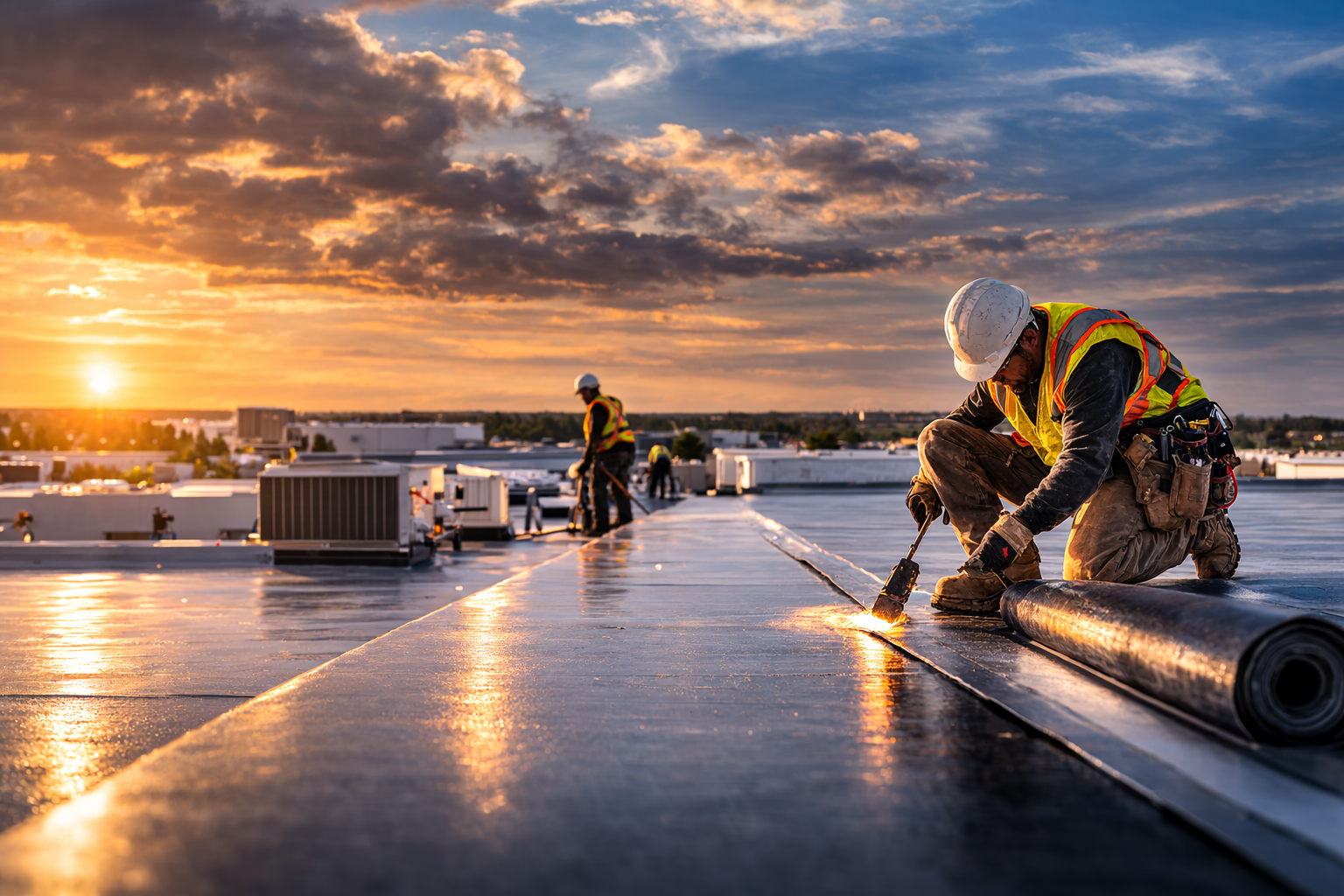
Commercial Roof Replacement
Tear-off and full replacement of commercial flat and low-slope roofs across the Tampa Bay metro - TPO, EPDM, PVC, modified bitumen - with FBC HVHZ compliance, Miami-Dade NOA documentation, and manufacturer-warranty closeout.
Full-system tear-off and replacement on Tampa Bay commercial flat and low-slope roofs - scoped against hurricane wind-uplift requirements under Florida Building Code HVHZ provisions, closed out with Miami-Dade NOA documentation and manufacturer warranty that holds up through the next storm season.
Most commercial roof replacements in the Tampa Bay market get scoped without accounting for the specific requirements that separate Florida from every other commercial roofing market in the country. Florida Building Code High-Velocity Hurricane Zone provisions require wind-uplift assemblies that exceed standard IBC design by a significant margin. Miami-Dade Notice of Acceptance product approvals are required for systems installed in the coastal HVHZ exposure counties of Hillsborough and Pinellas. And the salt-air environment within a few miles of Tampa Bay and the Gulf accelerates fastener and metal component corrosion at a rate that makes standard IBC-spec fastener patterns underperform their design life in this market.
Hurricane Milton's 2024 landfall at Siesta Key and its track across Hillsborough County is the calibration point for what Tampa Bay commercial buildings now need from a roof replacement scope. Buildings that went through replacement in the 2010 to 2020 window with standard TPO mechanically attached on code-minimum fastener patterns showed significantly different performance than those replaced with wind-uplift-engineered assemblies and Miami-Dade NOA-approved products. The difference is visible in the claims data: uplift failure at perimeter and corner zones on buildings with code-minimum patterns, intact membrane on buildings with HVHZ-engineered assemblies.
Our replacement scope starts with a roof walk and moisture-core pull on any roof we suspect has saturated insulation. We document deck condition, parapet flashing condition, drain status, every penetration, and every prior repair. The replacement scope then specifies the membrane with its Miami-Dade NOA approval number, the insulation stack to current Florida Energy Code R-value requirements, the fastener density engineered against the building's ASCE 7 wind zone and FBC HVHZ exposure classification, the manufacturer warranty path, and the maintenance contract that keeps the warranty active. The deliverable at closeout is the warranty document, the Miami-Dade NOA compliance record, the roof zone diagram with closeout photos, the maintenance contract, and a written record the next reroof cycle can build against.
When Replacement Is the Right Call in Tampa Bay
Recover-versus-replace is the first decision in any aging-roof scope. Tampa Bay's high-humidity subtropical climate means insulation saturation is common - moisture infiltrates the stack through minor membrane failures and does not fully dry out because the ambient humidity and daily rain cycle from June through September keeps the insulation from releasing it. We pull moisture cores in five to ten representative locations on roofs we suspect have saturation. If more than 25 percent of cores read wet, replacement is the honest scope. Recovering wet insulation traps the moisture, voids the new warranty, and typically produces the same leak failure within five years.
Deck condition is the second decision. Tampa Bay's salt-air environment accelerates corrosion of metal deck fasteners and deck flanges. Buildings within two to three miles of Tampa Bay or the Gulf often show accelerated fastener corrosion when we pull deck inspection ports under wet cores. Corroded deck fastening is a structural issue, not just a roofing issue - we document what we find and flag it for the structural engineer of record if the corrosion has progressed beyond surface rust.
Storm event history is the third factor. Hurricane Milton's 2024 Hillsborough track, Hurricane Idalia's 2023 Big Bend approach that produced storm surge across Pinellas and Hillsborough coastal areas, and Hurricane Ian's 2022 Lee County impact all produced insurance claims across Tampa Bay that are still working through the adjustment process. Buildings that received temporary dry-in after storm damage and have not yet completed a full replacement scope may have latent moisture in the insulation stack from the post-storm period before dry-in. Our assessment protocol specifically checks for post-storm insulation saturation patterns that differ from chronic leak patterns.
FBC HVHZ Compliance and Miami-Dade NOA Requirements
Florida Building Code Section 1521 governs roofing system design in the High-Velocity Hurricane Zone, which covers the coastal exposure areas of Hillsborough and Pinellas Counties. The HVHZ provisions require that every component of the roof assembly - membrane, insulation, fasteners, adhesive, and deck attachment - carry a Miami-Dade NOA product approval for the specific assembly configuration used. A membrane installed without the matching NOA approval for its specific attachment method and insulation combination is a code violation and voids the manufacturer's warranty.
We specify NOA-approved assemblies for every Tampa Bay coastal exposure project. The NOA number is recorded in the project specification and in the closeout package delivered at completion. For projects where the building owner's insurer requires FBC HVHZ compliance documentation, we produce the required assembly compliance record as part of closeout.
Beyond the HVHZ coastal zone, Florida Building Code wind-speed maps require wind-uplift assembly design for all of Hillsborough and Pinellas Counties at levels that exceed most other states. We calculate the required fastener pattern against the building's ASCE 7 Basic Wind Speed per the FBC 2023 wind map, the building's exposure category (Exposure C applies to most Tampa Bay coastal and near-coastal sites), and the roof zone - field, perimeter, and corner - with different design pressures applied to each zone. Buildings that have never had this calculation performed are almost certainly under-fastened at perimeter and corner zones.
Roof review
Get a written Tampa Bay commercial roof scope.
We document the roof condition, separate urgent repairs from capital work, and give ownership a practical path before money gets spent.