Commercial Roof Maintenance
Commercial roof maintenance contracts for Tampa Bay buildings - annual inspections, manufacturer warranty preservation, FBC HVHZ compliance documentation, hurricane readiness checks, and priority emergency response.
A commercial roof in Tampa Bay that is not on a documented maintenance program is both a warranty liability and a hurricane-season risk. Our maintenance contracts deliver the annual inspection record, FBC HVHZ compliance documentation, and manufacturer warranty support that Westshore Class A office, Port Tampa Bay logistics, and Ybor City historic commercial buildings require.
Every major commercial roofing manufacturer requires documented annual maintenance inspections to keep their warranty active through its full term. In a market with the claim activity Tampa Bay has seen through three consecutive active hurricane seasons - Ian 2022, Idalia 2023, Milton 2024 - a building owner who submits a hurricane damage claim against a manufacturer warranty and cannot produce the annual inspection record is in a difficult position. The insurer and the manufacturer both look for documented maintenance compliance before honoring claims. Buildings without that record are exposed.
Tampa Bay's subtropical climate makes the maintenance inspection cycle more consequential than in most markets. The June-through-September rain season delivers rain at rates and accumulated volumes that probe every deficiency in a commercial roof system. Drain blockage from organic debris accumulates faster in Tampa Bay's high-biomass subtropical environment than in northern climates - a drain that runs clear in March can be substantially restricted by pine needle and palm frond accumulation by June. A parapet flashing that is intact in April can be compromised by the first hard tropical rain in July. Maintenance inspection timing should be calibrated to identify and address these vulnerabilities before the peak storm season, not after.
Our maintenance contracts are written around the specific requirements of the building's manufacturer warranty - the inspection items, documentation format, and reporting timeline the manufacturer specifies in the warranty terms. We do not use a generic checklist. The maintenance protocol for a 20-year silicone coating warranty on a Westshore office building is different from the protocol for a 15-year TPO system warranty on a TIA-adjacent industrial building, and we document both accordingly. At the end of each annual inspection cycle, the building owner receives a written condition report that serves as both the manufacturer warranty documentation and the building's roof asset condition record for capital planning.
What a Tampa Bay Annual Maintenance Inspection Covers
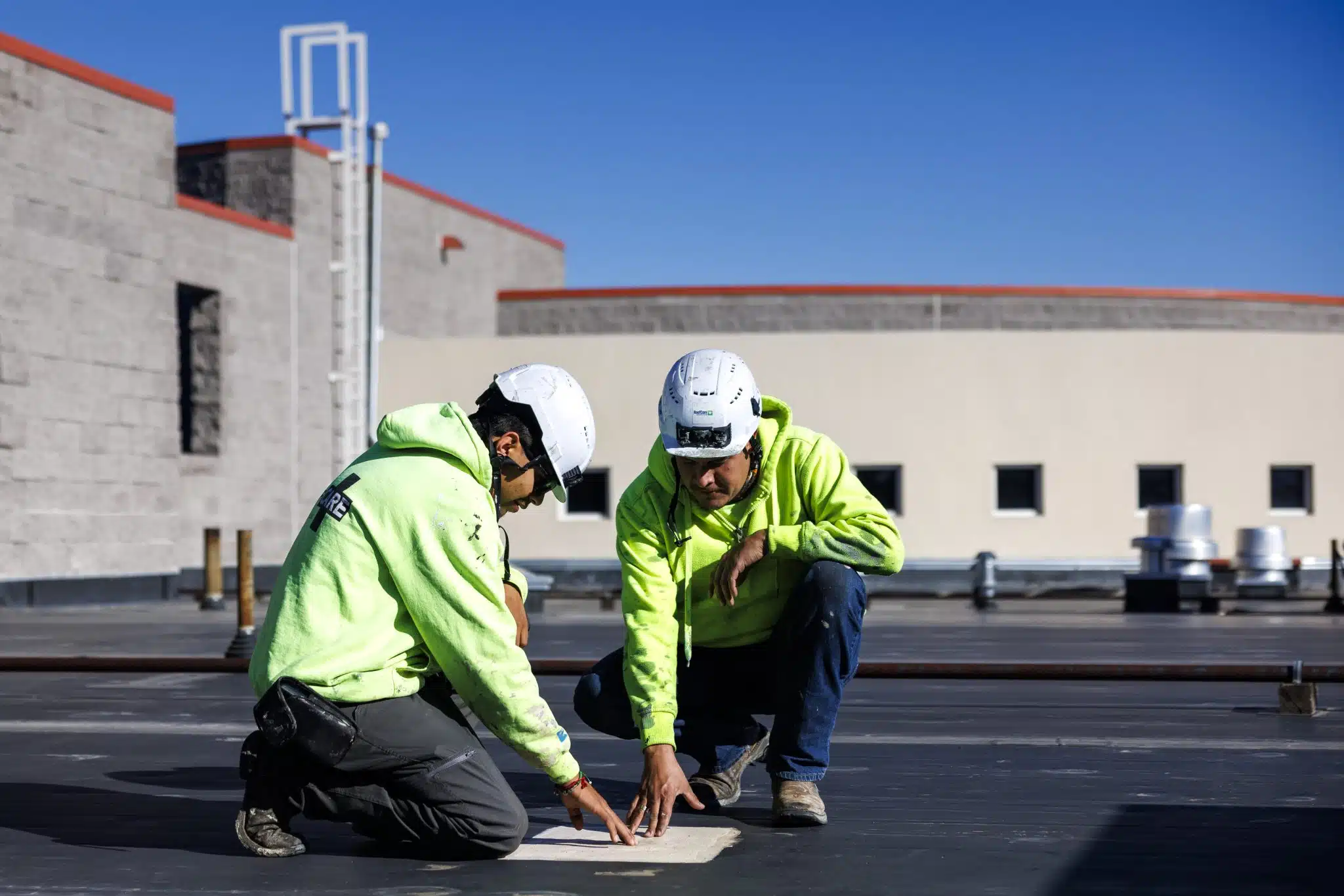
Every annual maintenance inspection we conduct on a Tampa Bay commercial building covers the full roof field and all perimeter and penetration conditions - not a representative sample. Roof field: we walk the entire field looking for membrane surface oxidation, blistering, ponding evidence (permanent staining or biological growth at ponding locations), seam condition at all field and perimeter seam runs, and any emerging delamination or fastener backout at the perimeter and corner zones that indicates wind-uplift stress from past storm events.
Drainage: every drain body, overflow drain, and scupper is inspected and cleared of organic debris accumulation. Tampa Bay's subtropical plant biomass - pine needles, palm fronds, and the aggressive Florida air-potato vine that roots wherever organic matter accumulates in drain sumps - builds up faster than in any northern market. A drain running at partial capacity heading into the June thunderstorm season is a preventable failure mode. We clear drains completely and verify that each drain connects freely to the storm drainage system by running water through the drain body.
Parapet flashing and terminations: the full perimeter of the building is inspected at every parapet, wall flashing, and termination bar. Salt-air corrosion of aluminum termination bar is the leading flashing failure mode on Tampa Bay buildings within two to three miles of the bay or Gulf, and it is detectable on inspection well before it produces an active leak - the oxidized aluminum forms a visible gap between the bar and the membrane. We document every flashing condition on the inspection map and recommend repair for any termination approaching active failure.
Penetrations and equipment: every pipe boot, conduit sleeve, HVAC curb, and rooftop equipment frame is inspected at the membrane transition. HVAC equipment is the highest-density penetration on most Tampa Bay commercial buildings - Westshore Class A office buildings and the medical and office buildings on the USF Health campus and in the Brandon corridor run heavy rooftop mechanical loads. Curb corners are the highest-stress flashing detail on the roof, and they are the first to show deterioration.
Hurricane Readiness Checks in the Maintenance Protocol
Our Tampa Bay maintenance protocol includes a pre-hurricane-season readiness check as a component of the annual inspection for all buildings on maintenance contracts. The readiness check specifically assesses: fastener pattern condition at perimeter and corner zones to identify any fastener backout or early uplift stress not visible from the field interior; parapet flashing attachment security at the most exposure-vulnerable elevations based on the building's orientation relative to prevailing Gulf storm approach angles; equipment curb attachment at rooftop mechanical units; and drain capacity relative to the current-code 100-year storm volume for the building's roof area.
Post-Hurricane Milton 2024, the readiness check protocol now includes a specific review of perimeter zone membrane condition for buildings that had any Milton wind exposure - even buildings without active post-storm leaks may show residual membrane tension at perimeter seam runs that are not visible without close inspection. We document these pre-failure indicators as a maintenance action item in the post-Milton inspection cycle.
Roof review
Get a written Tampa Bay commercial roof scope.
We document the roof condition, separate urgent repairs from capital work, and give ownership a practical path before money gets spent.