
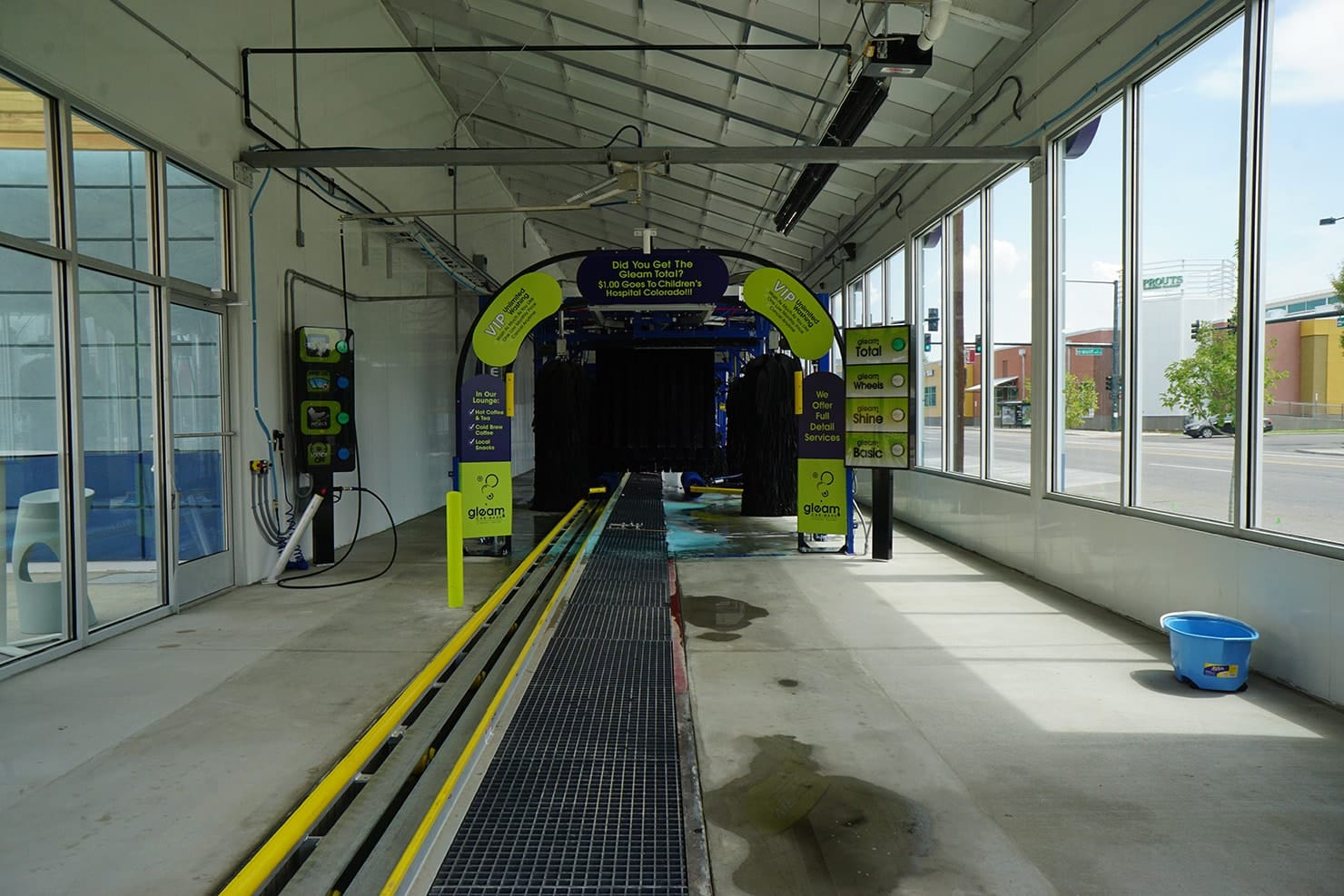
Car Wash Facility Roofing
Car wash roofing in Tampa, FL built for constant tunnel humidity and chemical vapor attacking the deck from below. PVC and corrosion-resistant systems for express, in-bay, and full-service washes.
A car wash roof fails from the inside out, and that is what most roofers miss when they bid one. We build and maintain wash-facility roofs across Tampa with the deck, the fasteners, and the underside of the membrane treated as the real problem, because in this building type the weather above the roof is rarely what takes it down first.
The roof problem nobody sees from the parking lot
Inside an active tunnel, the air sits at near-saturation humidity all day, carrying a fine mist of alkaline detergent, tire-dressing solvent, drying-agent surfactant, and acidic rust inhibitor. That vapor rises, hits the underside of the deck, and condenses on the steel, the fastener heads, and the back side of the membrane. On a steel-deck tunnel we routinely find corrosion blooming on screw shanks and deck flutes years before the top surface shows any wear at all. The roof can look serviceable from a drone photo and be quietly rotting where you cannot see it.
That single fact reorders the whole specification. Fastener metallurgy, deck protection, vapor control, and interior ventilation matter more here than the color of the membrane or its mil thickness on a brochure. We start every Tampa wash inspection from the underside.
Tampa makes it worse, predictably
This is one of the wettest, most humid metros in the country, and the wash-facility boom has tracked the region's growth corridors. The Dale Mabry Highway commercial strip, the Gandy and Westshore retail nodes, the State Road 60 run through Brandon, and the fast-developing US-301 and Big Bend stretches in Riverview are dense with express tunnels built in the last several years. When the outside air is already heavy with moisture for months at a time, the building envelope never gets the dry-out window a wash roof in a desert climate would get. Interior condensation that might self-correct elsewhere simply accumulates here. Add the summer convective storms rolling off the Gulf and the wind-driven rain that comes with them, and a tired edge detail leaks at exactly the moment the tunnel is busiest.
Why we usually land on PVC for the tunnel
The wash chemistry is the deciding factor. PVC membrane holds up to the alkaline detergents and wax compounds in a commercial wash program far better than TPO or EPDM, which is why we specify a 60-mil reinforced PVC, fully adhered or fleece-backed, over the tunnel bay on most jobs. Fully adhering it kills the membrane flutter that tunnel air pressure causes and removes the dense fastener field that a mechanically attached system would push down into a corroding deck. Before we commit, we get the actual chemical menu off the facility's supplier and confirm it against the manufacturer's compatibility data, because a standard single-ply warranty almost always carves out chemical exposure unless the system was selected for it on purpose.
The zones that actually leak
A wash property is not one roof, it is several small ones with different problems, and we price them as separate scopes:
The tunnel or bay deck, where humidity and vapor attack are worst and ventilation exhaust penetrations cluster.
The equipment room, carrying reclaim tanks, blowers, and the chemical dosing skid, with its own fume load.
Roof review
Get a written Tampa Bay commercial roof scope.
We document the roof condition, separate urgent repairs from capital work, and give ownership a practical path before money gets spent.