
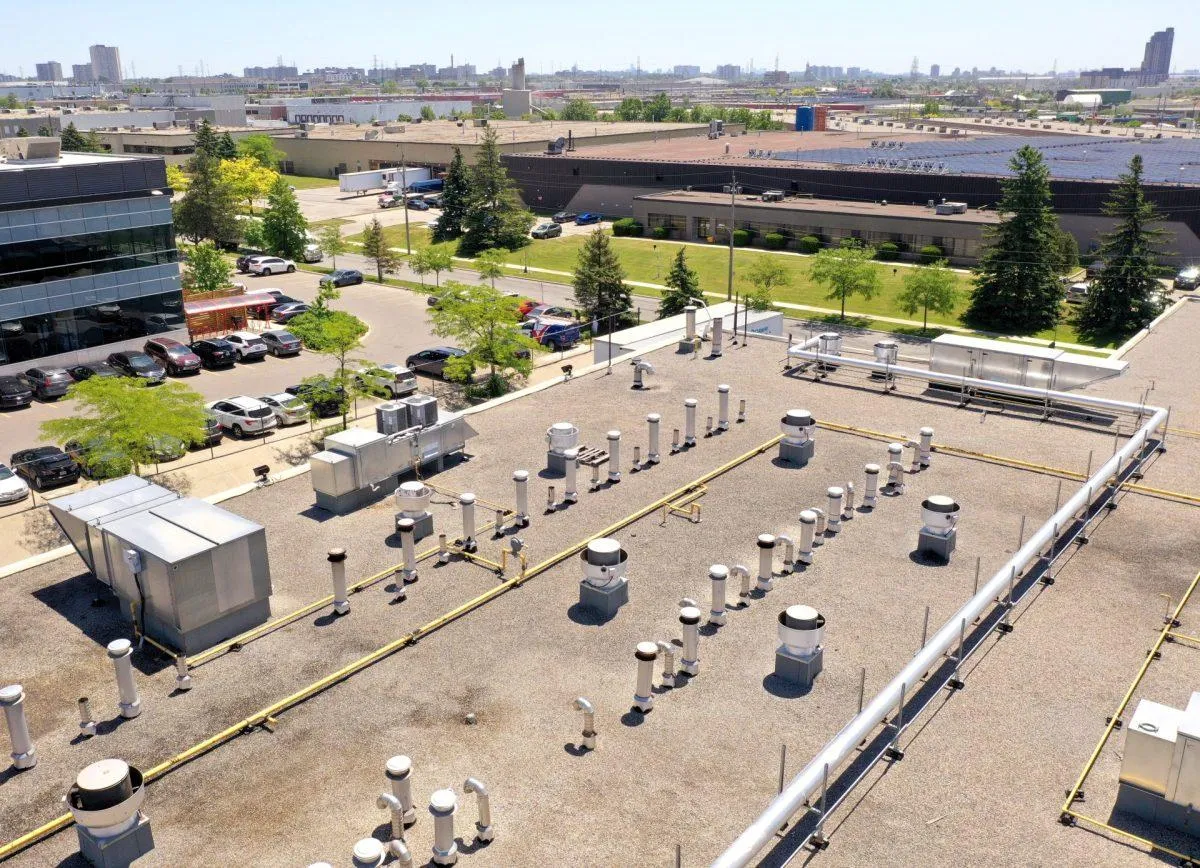
Food Processing Facility Roofing
Food processing roofing in Tampa, FL engineered for washdown humidity, heavy refrigeration and rooftop loads, and the food-safety rules that govern materials above a production floor.
Two forces fight over a food-plant roof at the same time, and a roofer who only plans for one of them will lose. From below, the production floor pushes a constant column of warm washdown moisture up against the deck. From above, the refrigeration racks, condensers, and process equipment press a heavy, concentrated load down onto it. We design food-processing roofs around both, on plants up and down the Tampa area.
Washdown is a humidity machine
A processing floor gets sanitized with hot water and caustic foam, often every shift, and that moisture does not simply drain away. It evaporates, rises, and presses against the underside of the deck as a near-constant vapor drive. If the roof assembly is built with the vapor retarder in the wrong place for a hot, wet climate, that moisture condenses inside the assembly, soaks the insulation, and corrodes a steel deck from the top side down, all without ever showing a single drip on the floor. By the time a leak appears, the insulation is already saturated across a wide area. We position the vapor control layer for what the floor and the Tampa climate actually do, not for a generic detail.
The roof is also a loading dock for mechanical equipment
Food plants carry more rooftop weight than almost any other low-slope building. Refrigeration condensing units, ammonia or glycol racks, large make-up air handlers, and process exhaust all live on the roof, and they concentrate dead load and vibration onto specific bays. Before we set any insulation thickness or attachment pattern, we confirm the deck can carry what is already up there plus anything being added. Equipment curbs and the dozens of refrigerant-line and conduit penetrations around them are flashed individually, because that congested mechanical zone is where these roofs leak first.
Cold rooms hide their own failure
The roof over a freezer, blast cell, or chill room is a thermal problem before it is a weatherproofing one. The assembly has to keep the cold chain continuous so the warm, humid air above does not condense against the cold deck below. Tapered insulation over a refrigerated bay in this climate has to be designed around the room's operating temperature and the direction the vapor wants to move, and water cannot be allowed to pond up there, because standing water both feeds condensation and adds thermal load the refrigeration system then has to fight. Getting this wrong rots the deck quietly and runs up the energy bill at the same time.
What you can put above food, and what you cannot
Not every membrane, adhesive, primer, or sealant is acceptable over a food-contact area. White TPO and PVC single-ply are generally workable above enclosed processing space, but the specific product and the way it goes down has to be confirmed against the plant's food-safety plan, and a lot of common roofing adhesives carry solvents that simply are not allowed in a production environment. We sort the approved materials with the plant's quality team before anything is ordered, not after a crew is standing on the roof.
Tampa runs on this industry
Food and beverage production is one of the region's real economic engines, and it clusters where the freight moves. Port Tampa Bay is the busiest port in the state and a major gateway for refrigerated and bulk food cargo, and the cold-storage and processing operations that feed off it line up along the Adamo Drive industrial spine, the East Tampa and Orient Road corridors, and the I-4 distribution belt running toward Plant City and Lakeland. Plant City's long agricultural base adds packing and produce-processing operations on top of that. These are humidity-heavy, refrigeration-heavy buildings sitting in one of the hottest, wettest metros in the country, which is exactly the combination that punishes a roof assembly that was not designed for it.
The production schedule writes the work plan
Roof review
Get a written Tampa Bay commercial roof scope.
We document the roof condition, separate urgent repairs from capital work, and give ownership a practical path before money gets spent.