
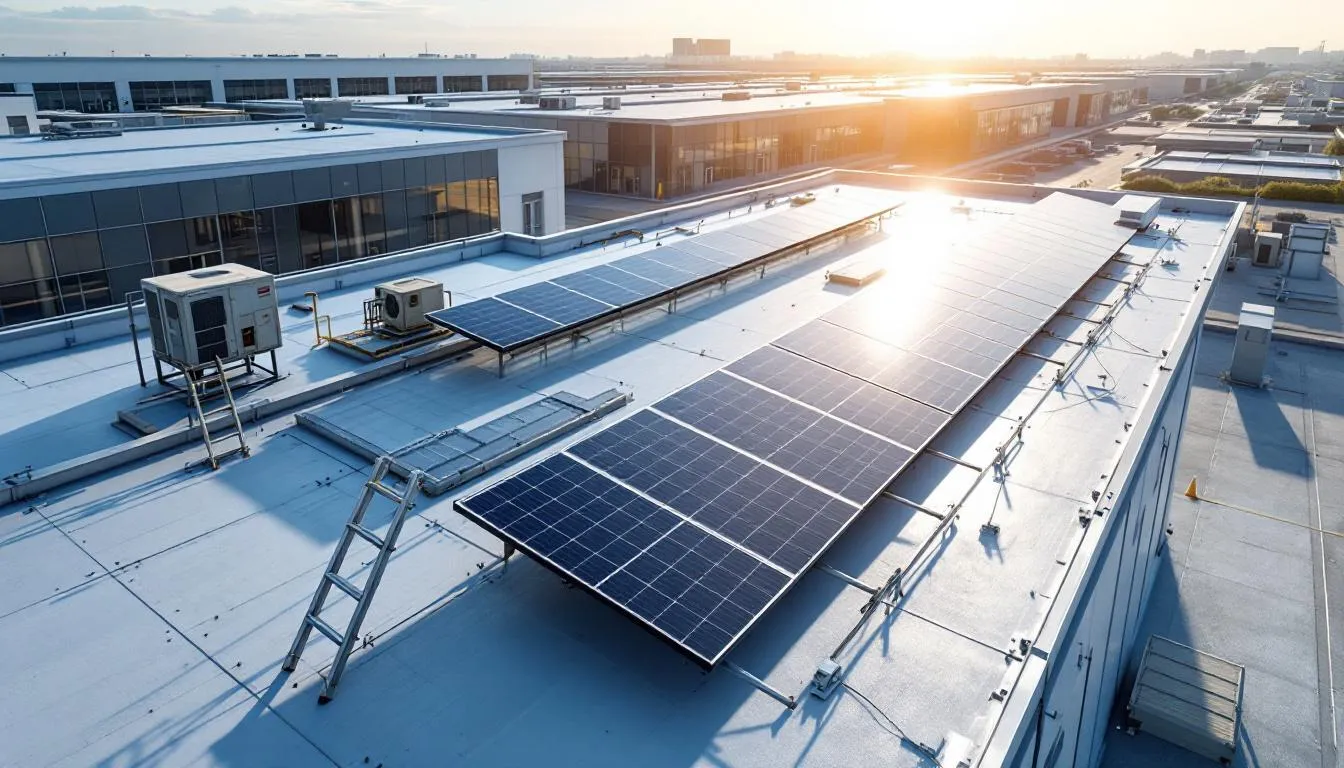
Industrial Flex Space Roofing
Flex space roofing in Tampa, FL built for multi-tenant low-slope buildings along the I-4 and Causeway corridors - penetration surveys, tenant-phased work, and wind-rated membrane.
Flex Buildings Have More Roof Penetrations Than Any Tenant Realizes
A flex building is really three or four buildings sharing one roof. The bay leased to a machine shop has a different mechanical footprint than the one a distributor uses for racking, which has a different footprint than the unit a contractor uses as office-plus-storage. We roof multi-tenant flex product across Tampa's biggest concentrations of it: the Sabal Park and Madison business parks east of I-75, the older inventory along Adamo Drive and Causeway Boulevard, the 50th Street and Orient Road industrial belt, and the newer shallow-bay parks pushing out toward Brandon and Riverview. What ties all of them together is that the roof gets modified every time a lease turns over, and almost none of those modifications are written down.
That single fact drives how we scope every flex project. Before we price anything, we walk the entire roof and build a penetration inventory - every curb, every pipe, every abandoned conduit stub, every patched-over opening from a unit that left two tenants ago. On a 60,000-square-foot flex roof we routinely find penetrations the property records don't show, because a previous tenant added a rooftop unit, ran a gas line, or cut in an exhaust fan and the as-built was never updated. Reroofing over an undocumented penetration is how a brand-new membrane leaks in its first wet season.
Tampa's Flex Inventory Spans Four Decades of Construction
The roofing approach depends heavily on when and how the building was built. We see a clear split across the market:
1970s and 1980s tilt-wall flex along Adamo, Hillsborough Avenue, and the older 50th Street corridor - typically built-up or early single-ply over lightweight insulating concrete or steel deck, often on its second or third roof by now.
1990s and 2000s concrete and masonry flex in Sabal Park and the East Lake area - usually a candidate for a mechanically attached single-ply tear-off over new polyiso.
Newer pre-engineered metal flex in the suburban parks - standing seam or R-panel where a metal restoration coating or retrofit recover often makes more sense than a full structural replacement.
We core every roof before we commit to a system. A core sample tells us how many membranes are already up there, whether the insulation is wet, and what the deck actually is - three things you cannot judge from the surface and all three of which change the price and the warranty.
Wind Uplift Is Not Optional on a Flex Roof Here
Hillsborough County sits in the High-Velocity Hurricane Zone's neighbor territory under the Florida Building Code, and a wide, low building full of independent tenants is exactly the kind of structure that fails at the perimeter and corners when the fastening pattern is wrong. Flex roofs are usually wide and squat, which puts enormous uplift demand on the edge metal and the field fasteners near the corners. We spec enhanced perimeter fastening, tested edge metal, and a membrane attachment rate that matches the building's actual exposure - not a generic field rate carried across the whole roof. For tilt-wall and concrete buildings, a 60-mil reinforced membrane mechanically attached over polyiso is the workhorse; for high-traffic roofs where multiple tenants' HVAC contractors are constantly walking the surface, we move up to a thicker membrane or add walkway protection.
Working a Roof While Five Tenants Stay Open
Roof review
Get a written Tampa Bay commercial roof scope.
We document the roof condition, separate urgent repairs from capital work, and give ownership a practical path before money gets spent.