
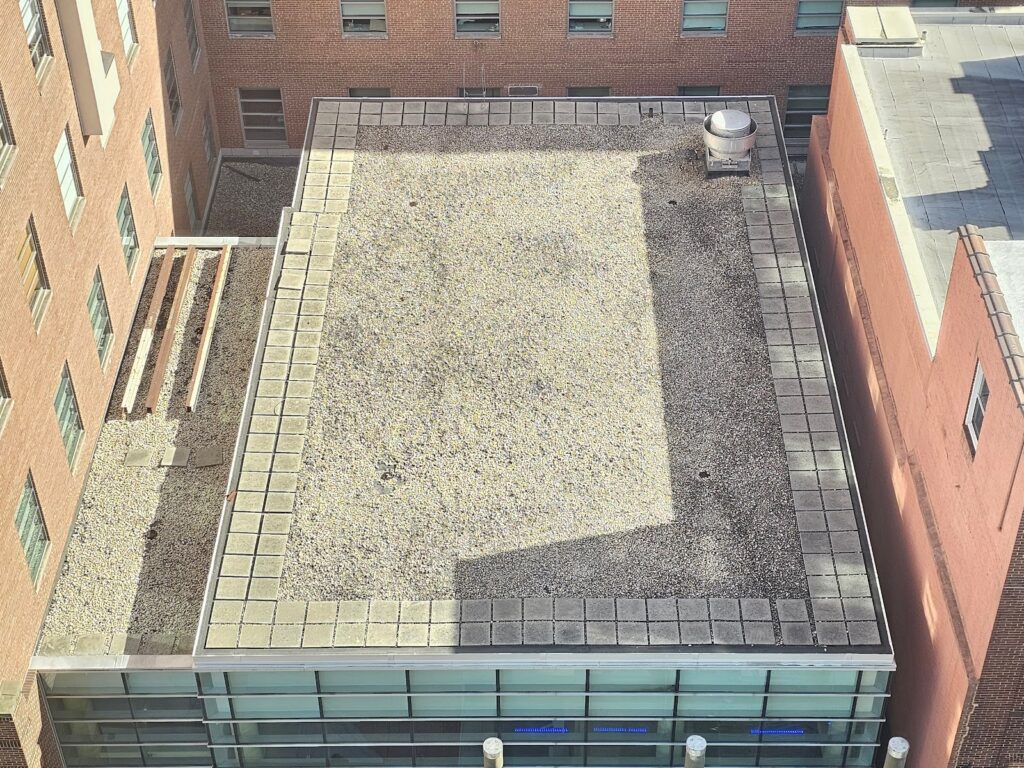
Ballasted Roof Systems Tampa Bay
Ballasted EPDM roofing assessment and replacement for Tampa Bay commercial buildings - hurricane wind uplift limitations, FBC HVHZ ballasted assembly compliance, drainage performance under Tampa Bay rain rates.
Ballasted roofing - a loose-laid EPDM membrane weighted by river-washed stone - is one of the oldest commercial flat-roof systems still in the Tampa Bay inventory, and one of the most misunderstood in the context of FBC HVHZ hurricane wind-uplift requirements. We assess ballasted systems, scope replacement, and advise on the limited conditions where ballasted assemblies remain a viable choice.
Ballasted roofing was installed extensively across Tampa Bay's commercial inventory through the 1970s and 1980s - it was the dominant system for commercial flat roofs of that era because it was inexpensive to install, did not require fasteners through the membrane, and provided good fire resistance from the aggregate ballast. The loose-laid EPDM membrane, weighted with approximately ten pounds per square foot of river-washed stone, relies on gravity to hold it in place against wind uplift rather than mechanical fastening or adhesive bonding.
The fundamental problem with ballasted roofing in the Tampa Bay hurricane market is that Florida Building Code HVHZ provisions do not permit loose-ballasted assemblies as the sole wind-uplift mechanism for commercial buildings in the coastal exposure zone. A ten-pound-per-square-foot ballast load provides approximately 10 psf of wind-uplift resistance. The required design pressure for perimeter and corner zones of a Tampa Bay HVHZ coastal commercial building is -40 to -70 psf. The ballast provides less than 25 percent of the required uplift resistance at those zones - the rest of the design pressure is borne by the membrane's deadweight and any perimeter restraint detailing, which is insufficient.
The existing ballasted roof inventory in Tampa Bay is a replacement priority. These systems are past their designed service life, they cannot meet current FBC HVHZ wind-uplift requirements without significant modification, and they present a specific hurricane risk that other aged systems do not: during a major hurricane event, ballast stone becomes projectile debris when wind forces exceed the ballast weight at the perimeter and corner zones. The National Roofing Contractors Association and FM Global both document ballast blow-off as a documented failure mode in hurricane events. We have assessed ballasted systems in the Pinellas Park industrial corridor and on TIA-adjacent industrial buildings where the ballast at the parapet perimeter was visibly displaced after Tropical Storm Elsa's 2021 Tampa Bay approach - a tropical storm, not a hurricane.
Why Ballasted Systems Are a Hurricane Risk in Tampa Bay
The aerodynamics of a flat commercial roof in a hurricane event produce uplift pressures that are highest at the roof edges and corners - the same locations where ballast stone is most likely to be mobilized by wind. At the perimeter strip - the first four to ten feet from each roof edge - the Bernoulli effect of wind flowing over the roof edge creates a low-pressure zone above the membrane that draws the membrane upward with forces that exceed the ballast weight. When uplift exceeds ballast weight, the membrane lifts, the stone slides toward the parapet, and the ballast that was providing the uplift resistance concentrates at the parapet rather than distributing across the membrane.
Hurricane Ian's 2022 track through Fort Myers documented ballast blow-off on commercial buildings across Lee County. Hurricane Milton's 2024 Hillsborough track produced ballast displacement at the perimeter zones of industrial buildings in the Tampa Bay area - including buildings along the TIA industrial ring and Pinellas Park industrial corridor that had ballasted systems on original 1970s and 1980s EPDM. The displaced ballast becomes projectile material that damages adjacent buildings, vehicles, and people, and creates liability exposure for the building owner that goes beyond the roof damage itself.
Florida Building Code does permit ballasted assemblies for commercial buildings outside the coastal HVHZ zone under specific conditions - minimum ballast weight calculated against the building's design wind pressure, perimeter restraint at the roof edge, and ballast aggregate gradation that meets FM Global Data Sheet 1-29. But for Hillsborough and Pinellas coastal HVHZ buildings, the ballasted assembly is not a code-compliant solution for the perimeter and corner zones. Buildings that currently have ballasted systems in the HVHZ zone are not code-compliant for current FBC HVHZ wind-uplift requirements.
Ballasted System Assessment Protocol for Tampa Bay Buildings
Ballasted EPDM assessment starts with a ballast surface walk to document aggregate depth, aggregate displacement pattern, and evidence of membrane exposure at the perimeter. Aggregate displacement - the migration of ballast stone toward the parapet from wind-loading events - is visible as a thin aggregate zone near the center of the roof and a thicker aggregate accumulation at the parapet. This pattern indicates past wind-uplift loading has been displacing aggregate over multiple storm seasons. We photograph and document the displacement pattern as part of the assessment record.
Underneath the ballast, EPDM in the Tampa Bay market shows a specific aging pattern: UV degradation at exposed membrane sections where the ballast has migrated away, thermal cycling cracks at seams that run beneath the ballast and are not visible without aggregate removal, and drain bowl corrosion from the combination of accumulated organic debris in the aggregate and the salt-air environment at coastal buildings. We remove aggregate samples from representative roof locations during assessment - three to five locations per 20,000 square feet - and probe the exposed membrane seams and drain flanges to assess condition.
Moisture core sampling under ballasted EPDM in Tampa Bay regularly finds insulation saturation that is not evident from the surface. The aggregate layer holds water after rain events and keeps the membrane wetted for extended periods - accelerating any membrane breach into insulation saturation faster than the same breach in a non-ballasted system where the surface dries between rain events. Buildings with saturated insulation under ballasted EPDM require full tear-off and replacement; recovery is not a viable scope when the insulation stack is wet.
Roof review
Get a written Tampa Bay commercial roof scope.
We document the roof condition, separate urgent repairs from capital work, and give ownership a practical path before money gets spent.