
Drone & Thermal Roof Inspection
FAA-compliant aerial and thermal drone roof inspections for Tampa commercial buildings - locate trapped moisture across large low-slope roofs with no foot traffic, plus adjuster-ready storm documentation.
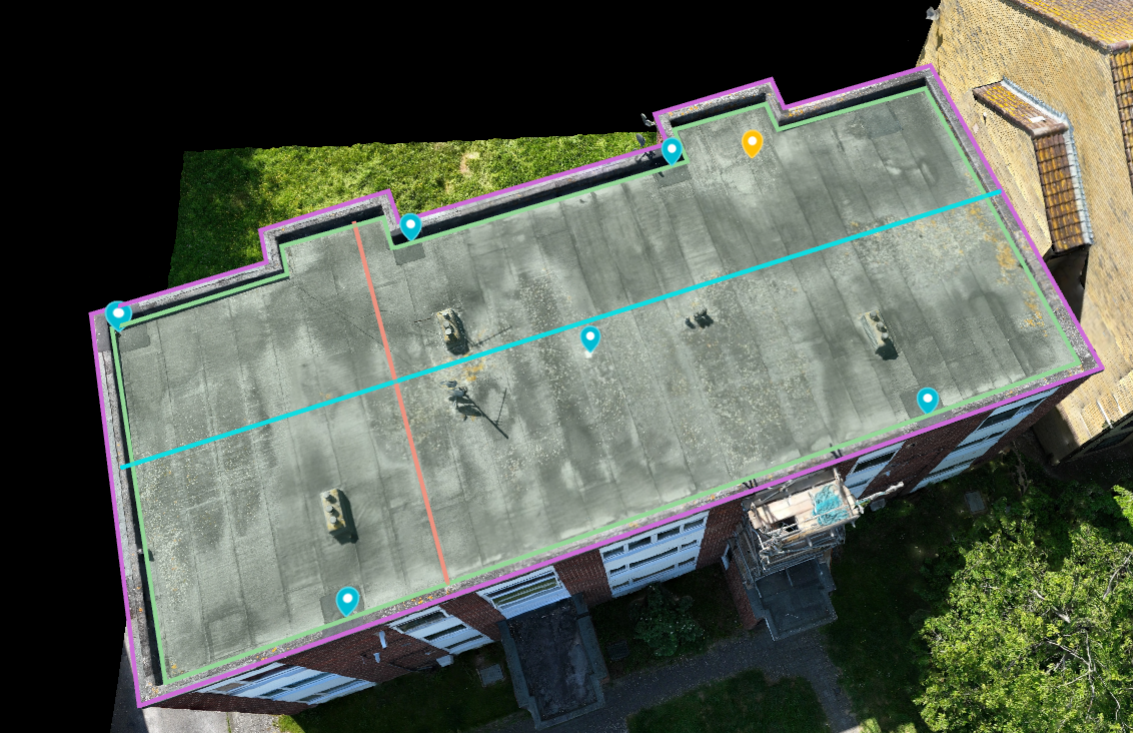
Some Tampa roofs are simply too large to inspect honestly on foot. The distribution centers feeding Port Tampa Bay, the long-span warehouses strung along Causeway Boulevard and Adamo Drive, the retail rooftops stretching out toward Brandon - a crew walking those acres of membrane covers a slice of it, steps around the ponded flats between drains, and grinds grit across the seams the entire time. Flying the roof changes the math. We capture the whole surface at a consistent altitude, build a complete photographic record, and find wet insulation without setting a single boot on a membrane whose condition we have not yet confirmed.
The thermal pass is what exposes the hidden damage
A high-resolution visual pass tells you what is happening on top of the roof - split seams, ponding rings, failed pitch pans, lifted flashing, choked drains. The thermal pass tells you what is happening inside the assembly, and that is where the expensive failures hide. Wet insulation holds the day's accumulated heat longer than the dry insulation around it, so once the sun drops it glows on an infrared image as a distinct warm patch while the dry roof has already shed its heat. On Tampa's broad low-slope roofs that signature is the whole game, because trapped moisture is the single costliest thing a roof can conceal and it rarely shows on the surface until the deck beneath it is already corroding. We fly the thermal sweep during the evening cool-down when the contrast between wet and dry peaks, then verify the flagged areas with test cuts so the moisture map is backed by physical cores rather than a flattering heat picture.
Why aerial mapping beats a walkover for moisture
A handheld infrared scan on a roof this size is slow and patchy - you cover what you can reach before the thermal window closes, and the viewing geometry keeps shifting. The drone sweeps the entire roof systematically inside that same window, at a fixed height and image overlap, so the frames stitch into one continuous moisture map instead of a scatter of disconnected readings. That completeness is what lets the map actually steer a decision. Where the wet zones are discrete and isolated, we are looking at a cut-and-patch repair. Where they sprawl across a large share of the roof, the conversation shifts toward a recover or full replacement. Either way the call is grounded in the whole roof, not a sample of it.
Flying legally and safely in Tampa's airspace
This is not hobby flying, and the Bay area is busy, controlled airspace. Every flight we run is piloted by an FAA Part 107 certificated remote pilot, and a great many of the commercial roofs we cover sit inside the controlled airspace ringing Tampa International, with more near Peter O. Knight on Davis Islands and the general-aviation traffic at Tampa Executive. Operating there means checking the airspace classification for the specific address and securing LAANC authorization before launch whenever the site lands in a controlled grid. We keep the aircraft within visual line of sight, brief the property manager on the flight plan, and stay clear of anyone on the ground beneath the flight path. None of that is optional, and a contractor who treats it as optional is exactly the kind of liability you do not want operating over your building.
Documentation an adjuster or a capital planner can actually use
After a hail or high-wind event in the Bay area, the real value of an aerial inspection is the evidence it produces. We deliver GPS-tagged imagery an adjuster can review remotely - impact locations and density, wind-displaced membrane, lifted edge metal, and damaged rooftop equipment - formatted to the documentation standard commercial carriers expect. Because no one had to wait for safe roof access, we can usually assemble a post-storm claim package fast, while the damage is still fresh and clearly attributable to the event. That same imagery pulls double duty for capital planning: a dated baseline of roof condition a facilities team can hold up against next year's flight to see what is genuinely deteriorating and budget against it instead of guessing.
Pre-construction surveys that head off change orders
Before a re-roofing scope ever gets written, a drone survey confirms the true roof area, pinpoints every curb, drain, penetration, and rooftop unit, and records existing conditions against the drawings. Designing off measured reality instead of an estimator's assumptions is how you avoid the RFIs and change orders that surface the moment a crew climbs up and finds three more penetrations and a drain nobody drew. On multi-building campuses and large single roofs, that front-end accuracy is worth more than the survey costs to fly.
Drone Roof Inspection Questions
Roof review
Get a written Tampa Bay commercial roof scope.
We document the roof condition, separate urgent repairs from capital work, and give ownership a practical path before money gets spent.