
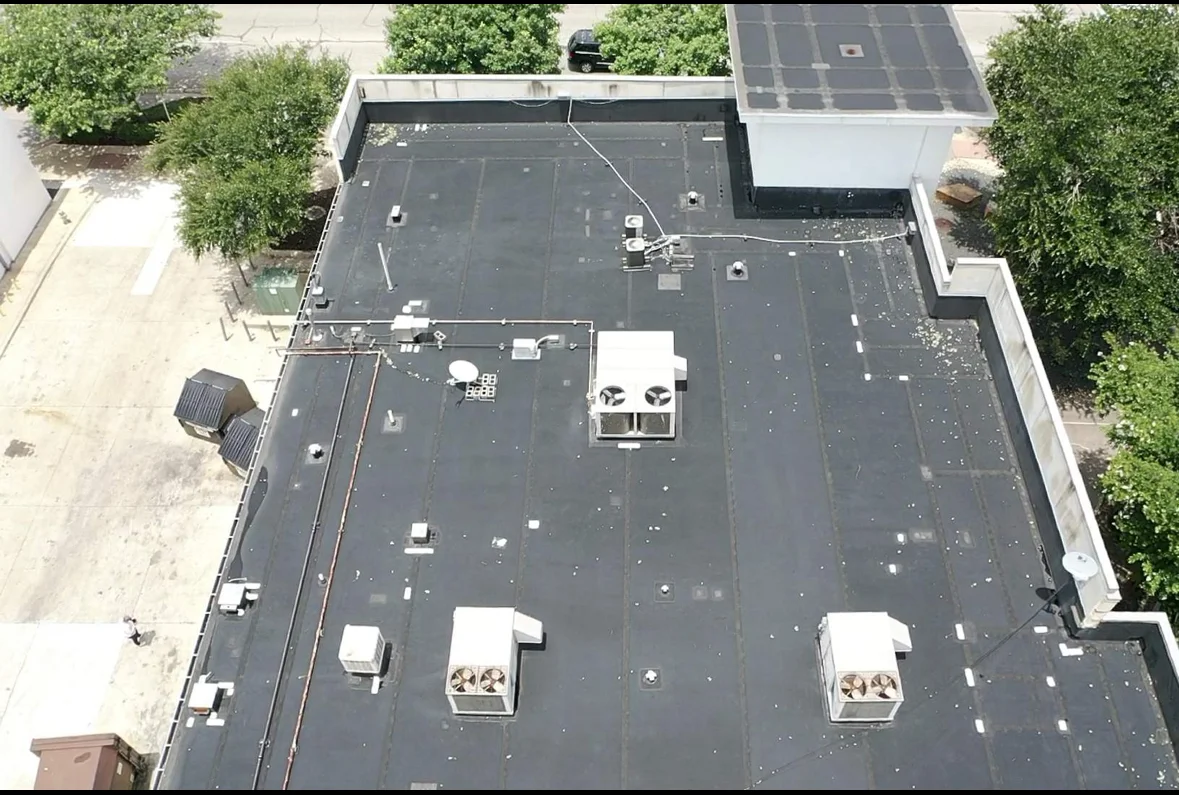
EPDM Roofing
EPDM commercial roofing for Tampa Bay flat and low-slope buildings - fully adhered and ballasted systems with Miami-Dade NOA approval, FBC HVHZ compliance, and salt-air-rated installation details.
EPDM commercial roofing systems installed across Tampa Bay with Miami-Dade NOA-approved assembly configurations, FBC HVHZ compliance, and coastal-rated installation details - Port Tampa Bay logistics, TIA-adjacent industrial, and the commercial corridors from Downtown Tampa to Brandon.
EPDM - ethylene propylene diene monomer - is a single-ply thermoset membrane that has been the dominant commercial flat roofing system for large-footprint industrial and logistics buildings across North America for five decades. In the Tampa Bay market, EPDM occupies a specific niche: it is the specification of choice for Port Tampa Bay logistics buildings and TIA-adjacent industrial facilities where the building footprint is large, the roof is simple in plan, and the long-term maintenance cost matters more than the upfront material cost. EPDM at 60-mil or 90-mil fully adhered carries documented service life expectations of 25 to 30 years in the Tampa Bay climate - longer than most TPO systems installed in the same period - and its thermoset chemistry means it does not plasticize or become brittle with age the way some thermoplastic membranes do under continuous UV exposure.
The Tampa Bay coastal environment introduces specific specification requirements for EPDM installations. Salt-air exposure within two to three miles of Tampa Bay or the Gulf requires stainless steel or hot-dipped galvanized heavy-zinc fasteners where the membrane is mechanically attached. EPDM splice tape - the seam adhesive used at field seams in glue-down or mechanically attached systems - must be rated for high-humidity application in the Tampa Bay climate, where the daily humidity cycle through the June-through-September storm season can prevent standard splice tape from achieving full adhesion if applied without the correct ambient conditions. We install splice tape with a heat gun activation step during high-humidity periods, and we monitor temperature and dew point at the membrane surface before applying seam adhesive - a step that many contractors skip and that produces seam failures at first major rain event.
Hurricane Milton's 2024 Hillsborough County track provided a field test of the EPDM systems installed across the Tampa Bay commercial market. Fully adhered 60-mil EPDM on NOA-approved substrates with correct perimeter and corner zone fastening performed well across the Port Tampa Bay and TIA-adjacent industrial buildings we assessed in the post-storm period. Mechanically attached systems with standard field fastener patterns applied uniformly to all zones showed the expected perimeter and corner stress pattern - the same failure mode that presents in TPO mechanically attached systems when HVHZ zone engineering is not applied.
Fully Adhered vs. Mechanically Attached EPDM in Tampa Bay
Fully adhered EPDM is our default specification for Tampa Bay buildings within the coastal HVHZ exposure zone. The fully adhered assembly achieves higher wind-uplift resistance than mechanically attached at equivalent membrane thickness, because the adhesive creates a continuous bond between the membrane and the insulation substrate rather than relying on discrete fastener points. For buildings where the NOA-approved fully adhered assembly's design pressure rating exceeds the building's calculated HVHZ requirement, fully adhered eliminates the perimeter and corner fastener pattern engineering complexity and removes the fastener corrosion risk entirely in salt-air environments.
Mechanically attached EPDM is appropriate for buildings outside the coastal HVHZ zone - eastern Hillsborough County commercial buildings in Brandon, Riverview, and Plant City corridors, and inland Pinellas County industrial buildings where the coastal HVHZ provisions do not apply. Mechanically attached reduces adhesive cost on large-footprint buildings and allows the membrane to move with thermal cycling without depending on adhesive bond integrity. The fastener pattern is engineered to the FBC wind zone and building exposure classification, with tighter patterns at the perimeter and corner zones as required by the structural calculation.
Ballasted EPDM - where the membrane is loosely laid over the insulation and held in place by river-washed gravel or pavers - is not appropriate for the Tampa Bay market given the Gulf Coast hurricane wind speeds. Ballasted systems can be engineered for wind uplift with increased ballast weight, but the ballast adds dead load to the structure and can become projectile material in a major hurricane event. We do not specify ballasted EPDM for Tampa Bay commercial buildings.
EPDM Seam and Splice Detail in Tampa Bay Humidity
EPDM seams are the highest-risk detail in any flat roof installation, and in Tampa Bay's humidity environment they require specific installation discipline. Factory seams - where the EPDM sheets are joined at the factory before delivery - are more reliable than field seams in high-humidity conditions. We specify the maximum practical factory sheet width for each installation to minimize field splice count.
Field splices on Tampa Bay EPDM installations use a three-step process: surface preparation with EPDM primer and a water break check at the seam surface, lap splice tape application with hand roller consolidation, and heat-gun seam activation on days where ambient humidity exceeds 70 percent. We monitor the membrane surface temperature and dew point with a contact thermometer before each splice application. When the surface temperature is within 5 degrees Fahrenheit of dew point - common in Tampa Bay's June-through-September humidity - the seam application is deferred until conditions improve, typically late morning after the surface has warmed above dew point.
Seam quality control on Tampa Bay EPDM installations includes a probe test of every field splice within 24 hours of application. A seam probe tool detects delamination or incomplete adhesion before the section is covered by subsequent work. Failed probe locations are repaired immediately and re-probed before proceeding. The probe test record is kept as part of the installation quality control file delivered at closeout.
Roof review
Get a written Tampa Bay commercial roof scope.
We document the roof condition, separate urgent repairs from capital work, and give ownership a practical path before money gets spent.