Infrared Moisture Scanning
Infrared thermography moisture scanning for Tampa Bay commercial roofs - aerial and walking-scan protocols that locate wet insulation in flat and low-slope systems before recover-or-replace decisions and after hurricane or storm events.
Tampa Bay's subtropical humidity means wet insulation does not dry out on its own - it stays wet, adds dead load, and voids the new warranty if you recover over it. Infrared thermography locates saturated sections in the insulation stack before we commit to a recover-or-replace scope, and it does so without destructive sampling across the entire roof.
The recover-versus-replace decision on a Tampa Bay commercial building hinges more on insulation saturation status than on membrane condition. A 15-year-old TPO membrane with surface crazing but dry insulation is a legitimate recover candidate. A 10-year-old membrane in acceptable visual condition over saturated polyisocyanurate is a replacement - recover over wet insulation traps the moisture, creates a biological load that accelerates membrane delamination, adds structural dead load that most original deck designs did not account for, and voids the new membrane warranty on day one.
Tampa Bay's climate makes the saturation problem worse than in most other commercial roofing markets. The June through September afternoon thunderstorm season delivers 30 to 35 of the city's annual 47 inches of rainfall in a 90-day window of high ambient humidity. Water that infiltrates the insulation stack through minor membrane failures during this period does not evaporate through the underside of the deck - the building's HVAC keeps the interior below the dew point - and does not evaporate through the membrane surface because the ambient humidity is consistently high enough to suppress the evaporation rate. Saturated polyiso in a Tampa Bay climate tends to stay saturated unless the affected section is mechanically removed.
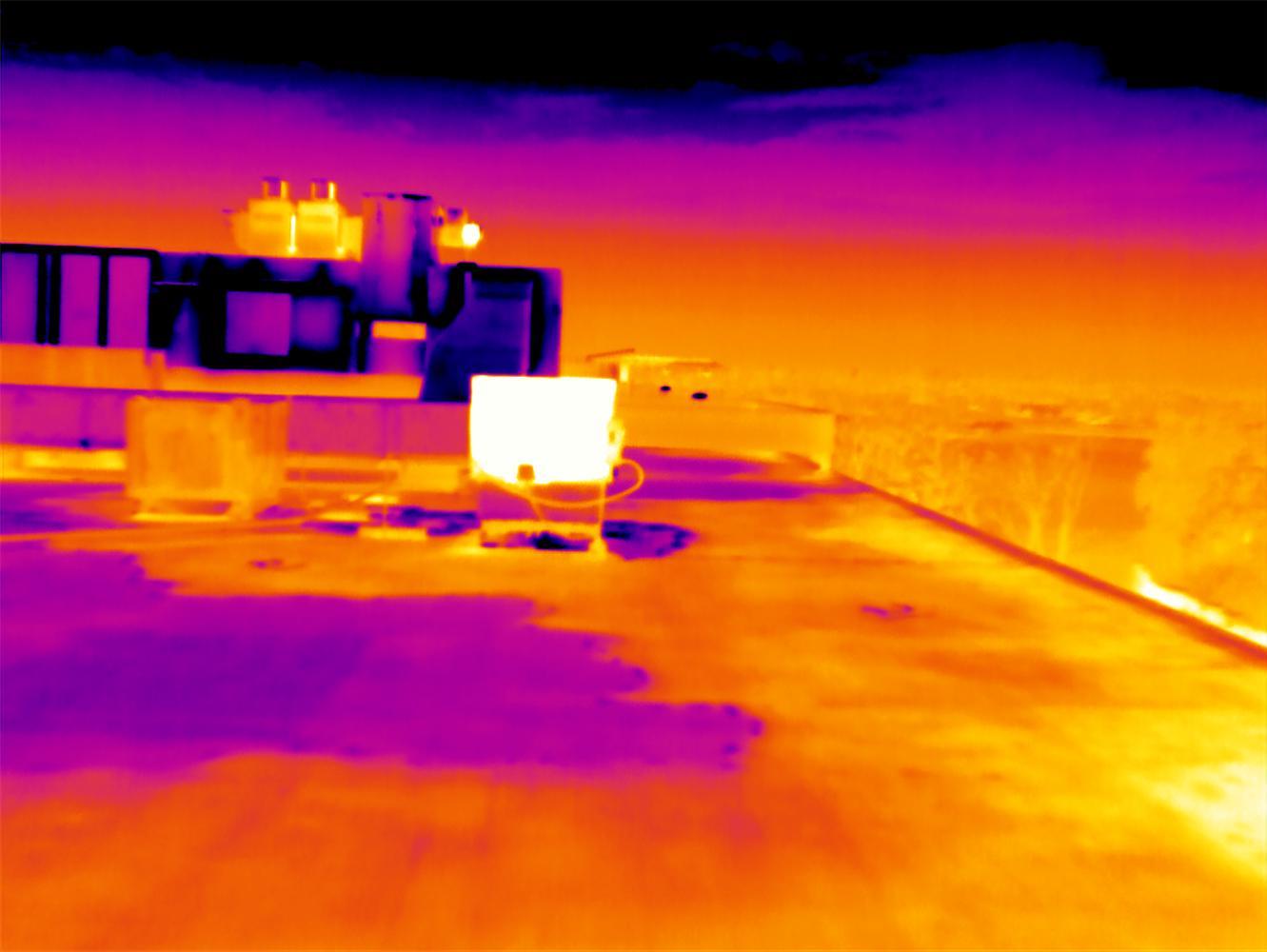
Infrared thermography is the most practical tool for mapping insulation saturation on a commercial flat roof because it covers large areas quickly without requiring destructive investigation across the entire roof. The thermal imaging principle is simple: wet insulation retains solar heat longer than dry insulation after the sun sets, because water has a much higher thermal mass than air-filled foam. A thermal camera scanning the roof surface after sunset will show warm areas - elevated radiant temperature from wet, heat-retaining insulation - against the cooler background of dry sections. We map those warm areas, correlate them with core sample verification points, and produce a moisture map that drives the recover-or-replace scope.
Tampa Bay Scan Timing - Why Sunset Matters Here
Infrared moisture scanning on commercial roofs works best in the two to three hours after sunset, when the membrane surface has cooled but the wet insulation underneath is still radiating stored solar heat at a detectable differential above the dry sections. In Tampa Bay's subtropical climate, that thermal window is reliable from October through April - the dry season, when clear skies allow adequate solar loading during the day and cooling after sunset.
During the wet season (June through September), afternoon cloud cover reduces the solar loading that drives the thermal differential, and the scan window after sunset can be compressed by lingering humidity and low overnight ambient temperature differentials. For commercial roofs that need moisture scanning during the wet season - typically buildings that have had a recent storm event and need damage documentation quickly - we use aerial drone-mounted thermal imaging to extend the coverage rate per hour, which lets us complete larger roofs within a tighter weather window.
The timing constraint has a practical implication for post-Milton and post-storm scanning: buildings that need to file insurance documentation within 30 days of a storm event in July or August often need a rapid scan regardless of ideal conditions. We have protocols for wet-season scanning that account for reduced thermal differential - larger scan areas require more core verification points when the thermal contrast is lower, and the report notes the reduced confidence level at specific areas when conditions were suboptimal.
Aerial Drone vs. Walking Scan - Which Protocol for Tampa Commercial Buildings
For commercial flat roofs above 30,000 square feet, aerial drone-mounted thermal imaging is faster and produces more complete coverage than a walking scan. A rooftop technician with a handheld camera covers roughly 5,000 to 8,000 square feet per hour in good conditions. A drone can cover 30,000 to 80,000 square feet per hour, depending on flight altitude and camera resolution. For a 200,000-square-foot distribution warehouse in the Port Tampa Bay logistics district or the TIA-adjacent industrial ring, a walking scan takes four or five nights of scanning. A drone scan takes one or two.
Walking scans retain an advantage on roofs with dense rooftop equipment, multiple HVAC units, and penetrations that create false positive thermal signatures from their own heat output. The downtown Tampa Class A office towers along the Westshore corridor and in the Water Street development have rooftop mechanical equipment concentrations that produce thermal signatures that can obscure underlying insulation saturation signals on aerial imagery. On those roofs, we combine a drone overview scan with a walking scan of the equipment-dense zones.
For roofs under 15,000 square feet - suburban commercial, Ybor City historic commercial, and neighborhood retail - a walking scan is typically adequate and avoids the flight authorization requirements that apply to commercial drone operations within the Tampa International Airport Class B airspace boundary. TIA's Class B airspace extends from the surface to 10,000 feet over a broad area of the Westshore and Hillsborough northwest quadrant. We carry Part 107 Remote Pilot certificates and coordinate with Tampa approach control for any scan within the TIA airspace boundary.
Roof review
Get a written Tampa Bay commercial roof scope.
We document the roof condition, separate urgent repairs from capital work, and give ownership a practical path before money gets spent.