Roof Recover Systems
Recover-over-existing commercial roofing systems for eligible Tampa Bay buildings - single-ply TPO, PVC, and modified bitumen recover over BUR and first-generation membrane, with FBC HVHZ compliance, moisture core prerequisite, and manufacturer warranty.
Recovering over an existing commercial roof avoids tear-off cost and landfill disposal - but only when the moisture core results confirm dry insulation, the existing membrane can structurally support the recover assembly, and the recover system carries Miami-Dade NOA approval for the specific substrate and attachment method.
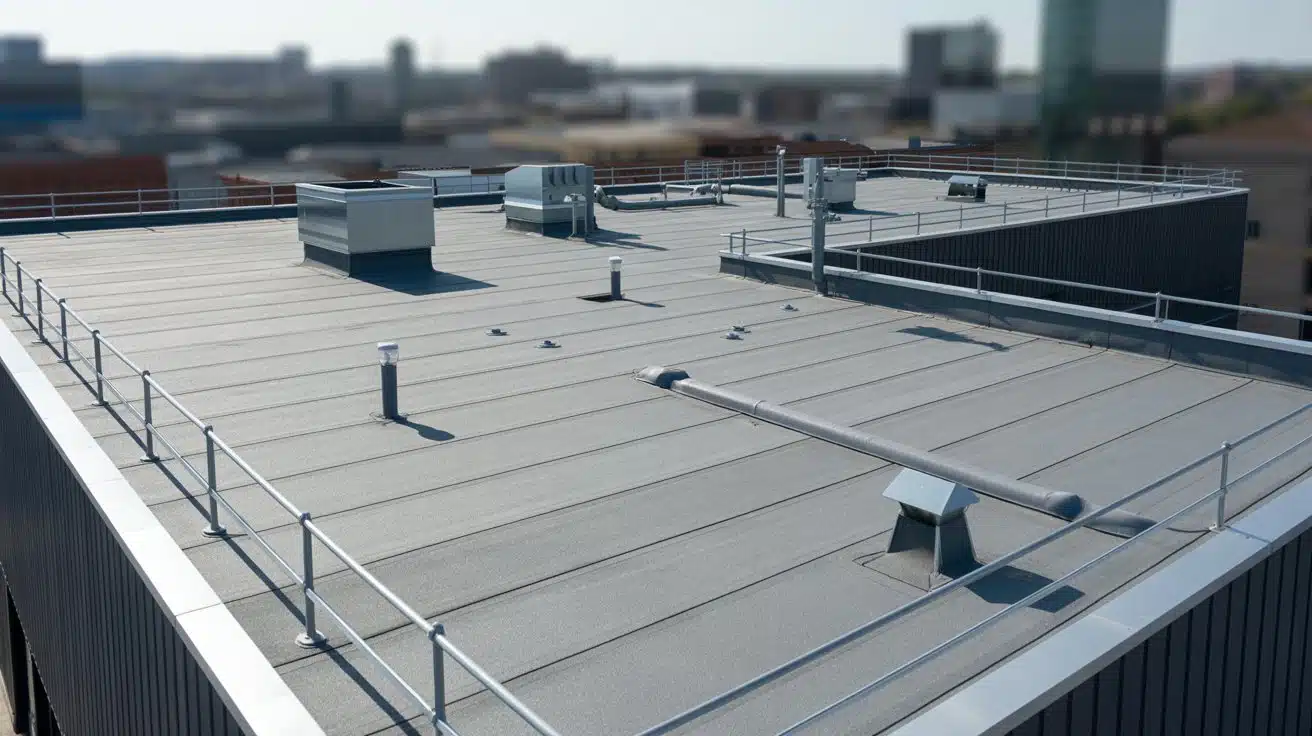
A commercial roof recover installs a new membrane system directly over the existing roofing without tear-off. Florida Building Code allows one recover over an existing roofing system before requiring a full tear-off to deck. The cost advantage is meaningful - avoiding tear-off and disposal on a 30,000 square foot commercial building in Tampa Bay saves $2 to $4 per square foot in direct cost, and eliminates the weather exposure risk that the tear-off open-deck window creates. When the conditions are right, a recover is the correct scope.
The conditions that make a recover correct in Tampa Bay are more specific than they appear. The existing roof must be the first roof on the building - if the building already has a recover over its original system, Florida Building Code requires tear-off to deck before a new membrane can be installed. The existing insulation must be dry on moisture core analysis - recovering over wet insulation traps the moisture, voids the new membrane warranty, and produces the same leak pattern within five years. The existing membrane surface must be stable enough to support the recover attachment without delaminating or displacing under the wind loads the recover system will transmit. And the combined assembly - existing system plus recover system - must achieve the required wind-uplift design pressure for the building's FBC HVHZ or standard FBC exposure classification.
That last requirement is where Tampa Bay recover projects most frequently encounter scope complications that other markets do not. The recover attachment to an existing mechanically attached membrane must transmit wind-uplift loads through the existing fastener pattern to the deck. If the existing fastener pattern was not engineered for the building's current FBC wind-speed requirement - and many 1990s and early 2000s commercial buildings in Tampa Bay were installed on pre-HVHZ enforcement fastener patterns - the recover assembly cannot achieve the required design pressure without a re-fastening of the existing membrane or a fully adhered recover that bypasses the existing fastener path.
Moisture Core Pre-Qualification - The Recover Go/No-Go Gate
We treat the moisture core results as a binary gate on recover eligibility. A building where more than 20 percent of cores read wet is not a recover candidate - it is a tear-off and replacement. This is not a conservative interpretation of the code: it is a warranty requirement. Every major single-ply membrane manufacturer's recover warranty explicitly requires documented dry insulation on pre-application core analysis. A recover warranty issued over wet-core results is a warranty that will not respond to a claim.
Core pull on recover candidate buildings in Tampa Bay requires attention to the insulation layer that is being covered, not just the membrane surface above it. BUR-to-single-ply recover projects - the most common recover scope in the Tampa Bay market - are recovering over a perlite or fiberboard insulation layer that may carry decades of accumulated moisture. We pull cores through the existing BUR membrane into the insulation layer and evaluate the full thickness of the insulation stack for saturation, not just the top inch that is visible when the core sample is extracted.
For large-footprint buildings in the TIA-adjacent industrial corridor or the Port Tampa Bay logistics district where a partial wet area is identified - typically less than 15 percent of the total area - a hybrid scope is often the right answer: tear-out and replacement of the wet areas down to dry insulation, followed by a recover over the remaining dry area. We map the wet-area boundaries precisely using the core grid results and specify the tear-out area to include a buffer zone around each wet-core location to ensure the recover attaches to a fully dry substrate.
FBC HVHZ Wind-Uplift Engineering for Recover Systems
A recover system installed on a Tampa Bay coastal commercial building must achieve the HVHZ required design pressure for the building's exposure classification and roof zone. This is a calculation we perform for every recover project before the specification is written. The calculation starts with the building's FBC 2023 Basic Wind Speed for its location within Hillsborough or Pinellas County, the building's height and exposure category (Exposure C for most coastal and near-coastal Tampa Bay sites), and the roof zone design pressures for field, perimeter, and corner.
The recover attachment method governs what design pressure the system can achieve. Mechanically attached recover systems transmit wind-uplift loads through the recover fasteners into the existing membrane and then through the existing membrane fasteners to the deck - the total assembly design pressure is limited by the weaker of the two fastener paths. If the existing membrane fastener pattern is under-designed for the current FBC requirement, the mechanically attached recover system is also under-designed regardless of the recover fastener density, because the uplift load path goes through both fastener sets.
Fully adhered recover systems bypass the existing fastener path by bonding the new membrane to the existing membrane surface - the uplift load path transfers from the new membrane through the adhesive bond to the existing membrane surface, not through the existing fasteners. This makes fully adhered recover the correct specification for buildings where the existing fastener pattern is insufficient for the current FBC requirement and re-fastening is not practical. We specify fully adhered recover on all Tampa Bay coastal HVHZ projects where the existing fastener pattern cannot be verified as code-compliant for the current wind-speed map.
Roof review
Get a written Tampa Bay commercial roof scope.
We document the roof condition, separate urgent repairs from capital work, and give ownership a practical path before money gets spent.