
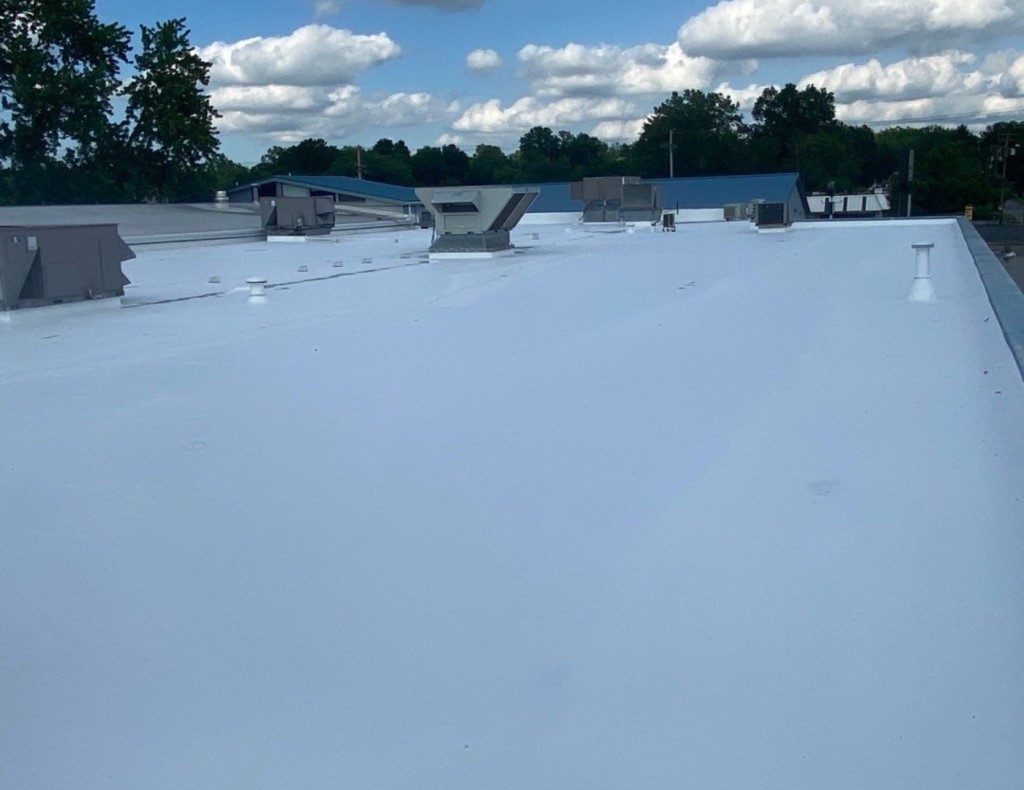
Single-Ply Roofing
Single-ply commercial roofing systems for Tampa Bay - TPO, EPDM, and PVC with Miami-Dade NOA approval, FBC HVHZ compliance, hurricane wind-uplift engineering, and salt-air-rated installation details.
Single-ply commercial roofing systems - TPO, EPDM, and PVC - installed across the Tampa Bay metro with Miami-Dade NOA-approved assemblies, FBC HVHZ wind-uplift compliance, and installation discipline calibrated to Tampa Bay's subtropical climate and Gulf Coast hurricane exposure.
Single-ply roofing covers the majority of Tampa Bay's new commercial construction and a substantial share of its replacement market. TPO mechanically attached is the volume specification for Westshore Class A office buildings, TIA-adjacent industrial facilities, and the suburban commercial corridors in Brandon, Riverview, and Plant City. EPDM fully adhered handles Port Tampa Bay logistics and large-footprint industrial buildings where service life and large-format installation economics favor the thermoset system. PVC fully adhered is the specification for buildings with chemical exposure - Ybor City restaurant corridors, Channelside hospitality, healthcare and laboratory facilities in the USF Health and Tampa General campus areas. Each membrane type has a specific place in the Tampa Bay commercial market, and selecting the right one requires understanding the building's coastal exposure classification, drainage conditions, chemical exposure profile, rooftop traffic pattern, and capital horizon.
The Florida Building Code HVHZ provisions are the defining regulatory requirement that separates the Tampa Bay single-ply market from virtually every other commercial roofing market in the United States. Miami-Dade NOA product approvals are required for every component of the roof assembly - membrane, attachment method, insulation, and deck type - on buildings in the Hillsborough and Pinellas County coastal HVHZ exposure zone. The NOA approval confirms that the specific assembly has been third-party tested and achieved the design pressure required for the building's coastal exposure. This is not a paperwork requirement - it is the documented basis for the assembly's hurricane wind-uplift performance.
Hurricane Milton's October 2024 landfall at Siesta Key and Category 3 track across Hillsborough County provided a field audit of the single-ply systems installed across the Tampa Bay metro. The post-storm assessment pattern was clear: assemblies installed with NOA-approved configurations and engineered perimeter and corner zone fastener patterns performed. Assemblies installed with standard IBC field fastener patterns applied uniformly to all zones showed perimeter and corner zone stress - some active membrane separation, more often residual tension cracking at the perimeter seam runs. The data from Milton 2024 has driven a wave of re-fastening and replacement projects across the Westshore corridor and the downtown Tampa office inventory that will run through the next several years.
Choosing the Right Single-Ply System for Your Tampa Bay Building
TPO is the right specification for the majority of Tampa Bay commercial buildings where chemical exposure is not a factor and where the roof slope and drainage conditions allow mechanically attached installation. 60-mil TPO mechanically attached with an NOA-approved assembly and engineered perimeter and corner zone fastener patterns is the cost-effective, code-compliant baseline for Westshore office, TIA-adjacent industrial, and suburban Brandon commercial buildings. The reflective white surface reduces cooling load in Tampa Bay's high-solar-gain subtropical climate, which matters for buildings with large cooling equipment inventories.
EPDM is the right specification for large-footprint buildings where service life and seam count economics favor the large-format thermoset system. Port Tampa Bay logistics facilities, the large-footprint distribution and light-industrial buildings in the TIA-adjacent industrial ring, and the newer big-box commercial buildings along the Brandon-to-Riverview SR-60 corridor represent the EPDM niche in the Tampa Bay market. Fully adhered 60-mil or 90-mil EPDM on these large-footprint buildings delivers a longer service life expectation than 60-mil TPO at a lower lifecycle cost per square foot when the installation economics of large-format sheets are fully accounted for.
PVC is the right specification for buildings with chemical exposure or where hot-air welded seam reliability in high-humidity installation conditions is worth the premium over adhesive-bonded EPDM or heat-welded TPO. Ybor City Seventh Avenue restaurant buildings, Channelside and Water Street Tampa hospitality properties, and hospital and laboratory facilities across the Tampa Bay metro are PVC specifications. For buildings in active development corridors like Water Street Tampa's 50-block mixed-use redevelopment district, PVC's long service life and seam reliability also fit the long-term building management approach of the development entity.
HVHZ Zone Engineering for Single-Ply Systems
Florida Building Code HVHZ wind-uplift compliance for single-ply roofing is an assembly-level engineering exercise, not a membrane selection. The process starts with the building's ASCE 7 Basic Wind Speed per the FBC 2023 wind map - 130 to 145 mph for most Hillsborough County locations, with higher values for the most exposed Gulf-facing coastal sites. The exposure category - Exposure C for most coastal and near-coastal Tampa Bay sites with open water fetch - determines the effective design wind pressure at each roof zone.
The field zone, perimeter zone, and corner zone each require different design pressures and different NOA-compliant fastener or adhesive attachment specifications. A building where the calculated field design pressure is -20 psf, the perimeter design pressure is -40 psf, and the corner design pressure is -65 psf must have three different attachment specifications within the same roof assembly. We produce a zone map overlaid on the roof plan showing the field, perimeter, and corner zones with their calculated design pressures and the corresponding NOA assembly configuration for each zone, delivered as part of the project specification.
For buildings that have undergone single-ply replacement in the period before the FBC HVHZ fastener pattern requirements were consistently enforced - roughly the 2005 to 2015 window in the Tampa Bay market - the current roof may not comply with the HVHZ zone fastener engineering requirement even if the membrane is otherwise in sound condition. Re-fastening - adding fasteners at the perimeter and corner zones to bring those zones up to current HVHZ design pressure requirements without full tear-off - is a targeted and cost-effective remediation for buildings where the membrane field is sound but the perimeter zones are under-fastened.
Roof review
Get a written Tampa Bay commercial roof scope.
We document the roof condition, separate urgent repairs from capital work, and give ownership a practical path before money gets spent.