Structural Roof Damage Assessment Tampa Commercial
Structural roof damage assessment for Tampa commercial buildings - deck deflection, load capacity evaluation, ponding-induced failure risk, post-hurricane structural documentation, and coordination with structural engineers for Hillsborough County commercial properties.
Commercial flat roof structural damage in Tampa is most commonly the product of deferred maintenance, not sudden events - chronic ponding that deflects the deck, insulation saturation that adds dead load, corrosion that reduces deck section modulus, or hurricane uplift that works fasteners and deck connections. We document what we find and coordinate with structural engineers for the analysis that determines what happens next.
Structural roof damage assessment is documentation, not structural engineering. Our role is to identify and document the visible evidence of structural concern on commercial flat roofs - deck deflection, corrosion indicators, load distribution anomalies, hurricane uplift evidence at deck connections - and produce a written, photo-documented record that a structural engineer can use to scope a structural analysis or design a repair. We do not make structural determinations; we produce the field documentation that makes structural determinations possible.
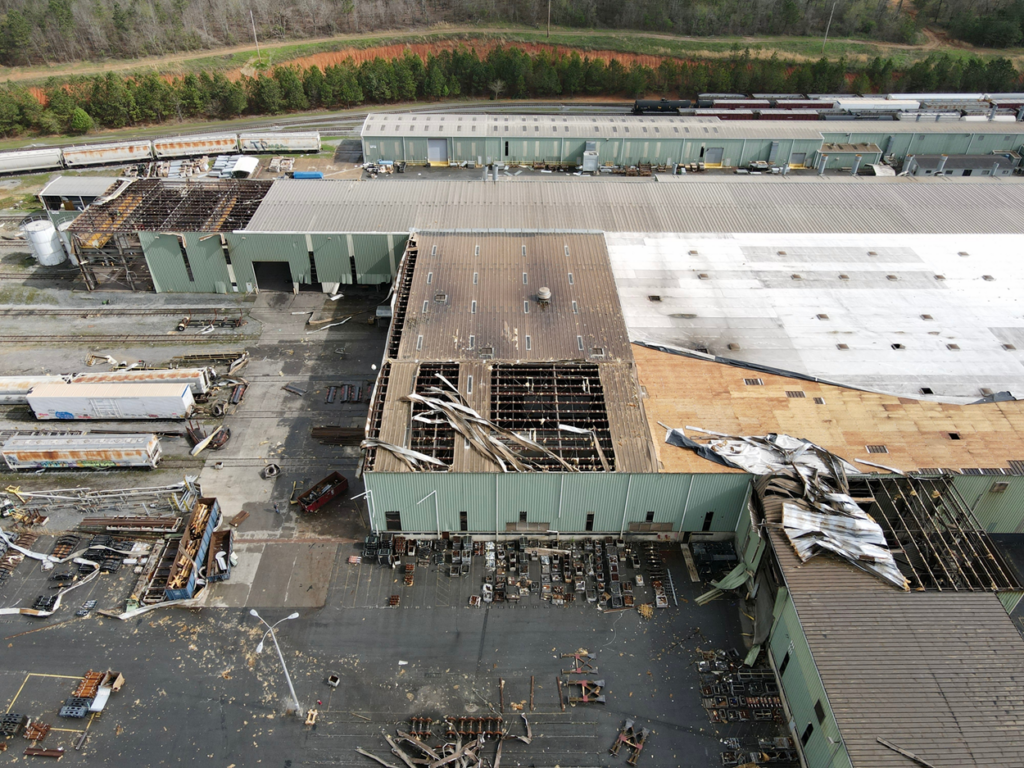
Tampa Bay's commercial building stock presents specific structural roof damage scenarios that reflect the local climate and hurricane history. Chronic ponding from inadequate drainage - common on older flat-roof buildings in the Westshore corridor, the Dale Mabry commercial strip, and the TIA industrial ring built in the 1980s and 1990s - has produced deflection in metal deck at low points where ponding occurs repeatedly over decades of operation. Hurricane Milton's 2024 Hillsborough County track produced uplift forces at perimeter and corner deck connections that were, in some cases, sufficient to deform the deck at the fastener point - creating a structural record of the uplift event in the deck itself. Salt-air corrosion of deck flanges on buildings near Tampa Bay has, in some cases, progressed to section loss that requires structural assessment before any additional dead load is placed on the deck.
The trigger for a structural roof damage assessment is not limited to obvious events. Routine roof inspection on a building with a history of chronic ponding should include a structural assessment review if the ponding has been persistent for more than five years. Post-hurricane assessment on any commercial building in the Hillsborough County wind zone should include a check for uplift-related deck deformation. And any building being scoped for a second recover - adding the third layer of roofing assembly - requires a structural review of the deck's dead load capacity before the recover scope is approved.
Deck Deflection and Ponding - Tampa Bay's Primary Structural Concern
Metal deck deflection from chronic ponding is the most common structural roof concern we document on Tampa Bay commercial buildings. The mechanism is straightforward: water that ponds on a flat roof adds dead load to the deck in the ponding zone; the deck deflects under the load; the deflected low point collects more water in the next rain event than the area around it; the additional water adds more load and drives additional deflection; and the cycle repeats over years until the deflected zone is visibly lower than the surrounding roof field. This progressive deflection is the ponding instability failure mode described in ASCE 7 and is explicitly addressed in Florida Building Code roof drainage design requirements.
We document deck deflection during roof inspection by measuring the relative elevation of the roof surface across the field using a floor level and straightedge at representative locations, noting the relationship between low points and drain locations, and photographing the ponding evidence - sediment rings, algae growth, and watermark lines that mark the boundary of chronic ponding zones. The documented deflection magnitude, ponding zone area, and relationship to drain capacity is the information the structural engineer needs to assess whether the deflection is within acceptable limits or requires remediation.
For Tampa Bay commercial buildings where deck deflection is visually significant - visible as a saddle or depression in the roof field that is apparent from the parapet or an adjacent building - we recommend a structural engineer consultation before proceeding with any roofing scope. Adding a tapered insulation recover to a deflected deck increases the dead load in the already-deflected zone and can accelerate the deflection if the deck is at or near its structural capacity.
Post-Hurricane Deck Connection Assessment
Hurricane uplift forces act on the roof deck through the attachment points - the screws, clips, and welds that connect the deck to the structural framing below. When uplift forces exceed the design capacity of these attachments, the deck deforms at the attachment point: the deck flute pulls upward, the fastener bends or shears, and the deck sheet lifts partially from the framing. This deformation may be small enough to be non-visible from the roof surface but is detectable from below - in the exposed deck spaces common in Tampa Bay warehouses and distribution facilities, we can inspect the deck-to-joist connection directly from the building interior.
After Hurricane Milton's 2024 Hillsborough County track, we conducted post-hurricane structural assessments on a number of Westshore and TIA-adjacent commercial buildings where the wind-uplift damage to the membrane suggested that the deck connections had been stressed. The assessment from below the deck documented the fastener condition at each deck-to-framing connection in the perimeter and corner zones - the zones where the highest uplift design pressures apply. Buildings that showed fastener deformation or weld cracking at these connections were flagged for structural engineer review before any roofing repair proceeded.
The relevance of post-hurricane deck connection assessment extends beyond the current storm event. A deck connection that has been partially deformed by uplift force - fastener bent, weld cracked but not fully failed - has a reduced capacity for the next storm event. A building whose deck connections were stressed by Milton but not assessed is at higher risk in the next major hurricane than a building that was assessed and repaired. This is the honest explanation we give building owners when the question is whether the assessment is worth the cost.
Roof review
Get a written Tampa Bay commercial roof scope.
We document the roof condition, separate urgent repairs from capital work, and give ownership a practical path before money gets spent.