Wind Damage Roof Repair Tampa Commercial
Wind damage roof repair for Tampa commercial buildings - perimeter uplift, seam separation, parapet flashing failure, FBC HVHZ re-fastening, and documentation for insurance claims after tropical storms, tornadoes, and severe thunderstorms.
Tampa Bay's wind damage risk does not begin and end with named hurricanes. The summer thunderstorm season produces straight-line wind events, embedded tornadoes, and microburst downdrafts that regularly exceed 60 mph across Hillsborough County - enough to lift under-fastened perimeter zones, separate aged seams, and blow off parapet coping on commercial flat roofs throughout the metropolitan area.
Wind damage on Tampa Bay commercial roofs is a year-round problem, not just a hurricane-season concern. Tampa's geographic position at the convergence of Gulf of Mexico and Tampa Bay sea breezes makes the city one of the most consistently thunderstorm-active locations in the continental United States between June and September. The National Weather Service Tampa Bay Area office regularly issues severe thunderstorm warnings with wind gusts in the 60-to-80-mph range across Hillsborough County - wind speeds sufficient to produce the same perimeter zone uplift pattern as a tropical storm.
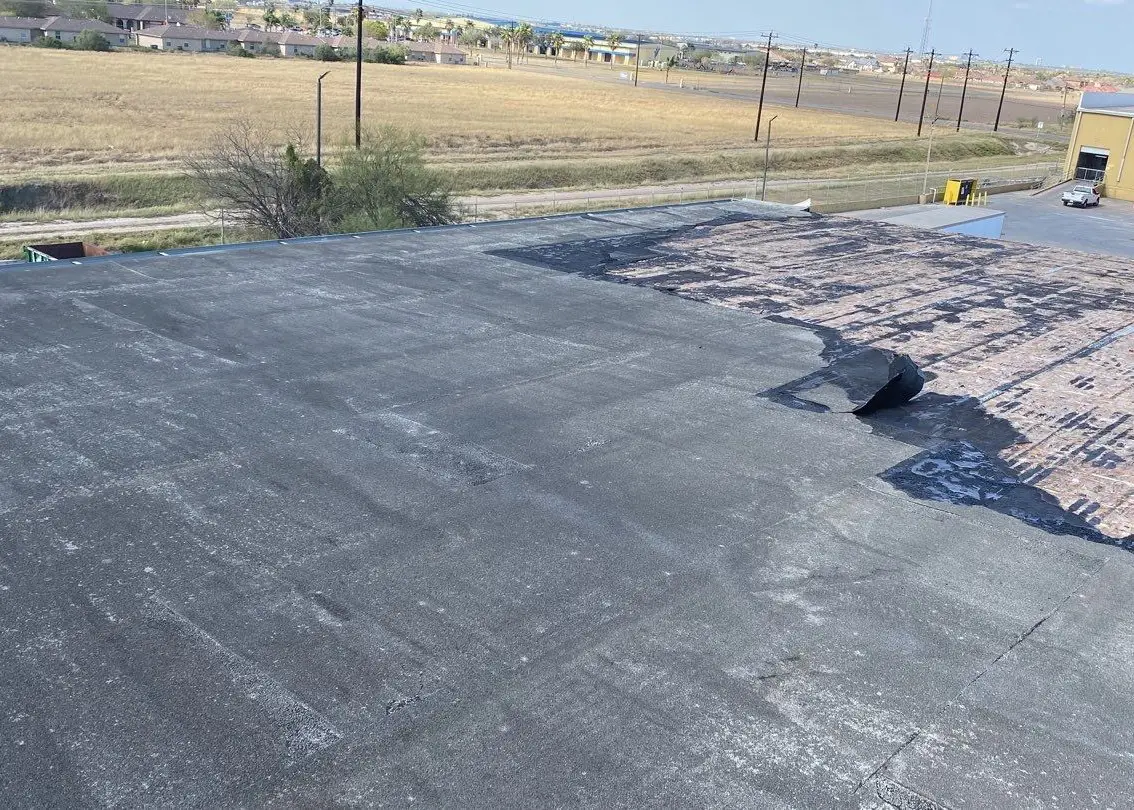
The specific mechanism of wind damage on a commercial flat roof is worth understanding because it determines the correct repair scope. Wind uplift does not peel the membrane from the center out - it attacks the edges first. The perimeter and corner zones of a flat commercial roof experience design pressures two to three times higher than the field because of the wind separation and vortex effects that develop at building edges. A membrane with a code-minimum field fastener pattern applied uniformly across all zones is under-designed for the perimeter and corner pressures that a Tampa summer thunderstorm can produce. When we find wind damage on a commercial roof, the repair scope addresses the failure mode - re-fastening the affected zones to the required design pressure - not just the visible evidence of the failure.
Tornado spin-ups embedded in Tampa Bay thunderstorm cells are a less-discussed but documented wind risk for the metro area. Pinellas and Hillsborough Counties average two to four tornado warnings per year, most associated with outer bands of tropical systems or strong summer squall lines. Tornado-related wind damage on commercial roofs produces a different physical pattern than straight-line wind: rotational membrane lifting that can affect field zones as well as perimeter zones, equipment curb wrapping, and HVAC equipment displacement that requires roofing and mechanical coordination in the repair scope.
How We Identify and Document Wind Damage on Tampa Commercial Roofs
Wind damage assessment starts with the wind direction. Every significant wind event has a documented track from National Weather Service records, and the damage pattern on a commercial roof should correlate with that track. Perimeter membrane separation on the upwind face, seam stress cracking perpendicular to the wind direction, coping displacement on the parapet walls facing the wind - these findings corroborate a wind damage cause in the insurance documentation. Findings that are inconsistent with the wind direction - aging seam separations on the downwind face, field membrane crazing not associated with perimeter uplift - are pre-existing conditions that we document separately.
Fastener back-out is the most common physical finding on wind-damaged commercial roofs in Tampa Bay. When the perimeter zone membrane lifts under uplift pressure and the fasteners partially pull through the deck, the fastener head rises above the membrane surface and is visible as a bump or raised point. We photograph and count fastener back-out locations in the damaged zones, which gives the adjuster a direct count of the wind-stressed attachment points and supports the re-fastening scope in the claim.
Seam stress cracking at the perimeter zone is the second most common finding. Membrane seams are welded or adhered at the factory overlap, and under wind uplift the seam is placed in tension perpendicular to the weld line. When the tension exceeds the seam strength, the seam opens - typically starting at the weld edge and propagating across the weld width. Fresh seam cracks have clean, non-oxidized break surfaces. Pre-existing seam separation has oxidized, granule-covered edges. This distinction is documentable in photographs and is the primary basis for separating storm damage from pre-existing wear in the claim report.
Perimeter Re-Fastening to FBC HVHZ Requirements
The permanent repair for wind-related perimeter zone uplift is re-fastening the affected zones to the design pressure required by Florida Building Code for the building's exposure classification. For most commercial buildings in the Hillsborough County Exposure C classification, this means installing additional fasteners in the perimeter strip - typically the first 10 percent of the building width from each edge - at a pattern calculated against the building's ASCE 7 Basic Wind Speed and roof zone design pressure requirements.
Re-fastening a perimeter zone without replacing the membrane is possible when the membrane is structurally sound and the seams are intact. The existing membrane is cut at the perimeter strip, the insulation is partially lifted, additional fasteners are installed at the required pattern, and the membrane is re-welded over the new fastener zone. The result is a re-fastened assembly that meets current FBC HVHZ requirements, documented with a post-repair inspection photo record. This scope is significantly less expensive than a full perimeter zone replacement and is the correct repair for wind damage where the membrane itself was not torn or punctured.
For buildings where the wind event revealed that the entire roof assembly is under-fastened - not just the damaged perimeter zone - the repair scope may extend to a full roof re-fastening. We approach this conversation with building owners honestly: if the perimeter zone failure is a symptom of a system-wide under-fastening condition, repairing only the failed zone leaves the building at risk in the next wind event. The insurance claim supports the damaged zone repair; the building owner's capital planning decision is whether to extend the re-fastening scope to the full roof while the contractor is already on-site.
Roof review
Get a written Tampa Bay commercial roof scope.
We document the roof condition, separate urgent repairs from capital work, and give ownership a practical path before money gets spent.